A Pro Player's Look at PUBG's Post-DMR Rebalance Gunplay Evolution
PUBG's Update 37.1 DMR Rebalance slashed DMR usage and damage, lifting SR and SMG pick rates to create a healthier weapon meta.
As a professional player, I have been paying very close attention to how PUBG's weapon ecosystem has shifted since the DMR Rebalance arrived with Update 37.1. The changes were not just a simple stat tweak; they completely reshaped how mid-range and long-range combat feels, especially in Ranked. Before the update, designated marksman rifles were so dominant that they often felt like the only correct choice after the early game. Now, I am seeing a much healthier mix of assault rifles, sniper rifles, and DMRs, and I want to break down what the latest Dev Letter data tells us about this evolving gunplay meta.
The Weapon Usage Shift
The most immediate change is weapon usage. In Normal Match, DMR usage fell from 16.3% to 10.5%, a drop of 5.8 percentage points. In Ranked, the decline was even sharper: from 20.6% to 13.0%, a reduction of 7.6 percentage points. As a competitor, I felt this almost overnight. Squads that used to run double DMR setups suddenly started carrying bolt-action snipers again, and fights became less predictable.
At the same time, sniper rifle usage rose from 13.1% to 16.4% in Normal Match and from 10.6% to 13.8% in Ranked. This means SRs now exceed DMRs in Normal Match and are nearly level with them in Ranked. SMGs also became more common in Ranked, which is a notable shift because previously they were mainly a Normal Match comfort pick. The overall picture is clear: when DMR dominance declined, the share of other weapon categories expanded, and that is exactly what a healthy ecosystem should look like.
| Weapon Type | Normal Match Before | Normal Match After | Ranked Before | Ranked After |
|---|---|---|---|---|
| DMR | 16.3% | 10.5% | 20.6% | 13.0% |
| SR | 13.1% | 16.4% | 10.6% | 13.8% |
Mid-to-Late Game Power Graphs
Power Graphs are one of the most useful tools for understanding how a weapon's impact changes over the course of a match. Mid-range engagements are most frequent around the 22-minute mark, and the kill ratios at that moment tell a very interesting story. Before the rebalance, DMRs recorded 26.9% of kills, which was more than double the 12.7% of SRs. After Update 37.1, DMRs dropped to 18.6%, while SRs climbed to 17.6%. That is a remarkably even split and shows that bolt-action rifles are no longer just niche high-risk choices.
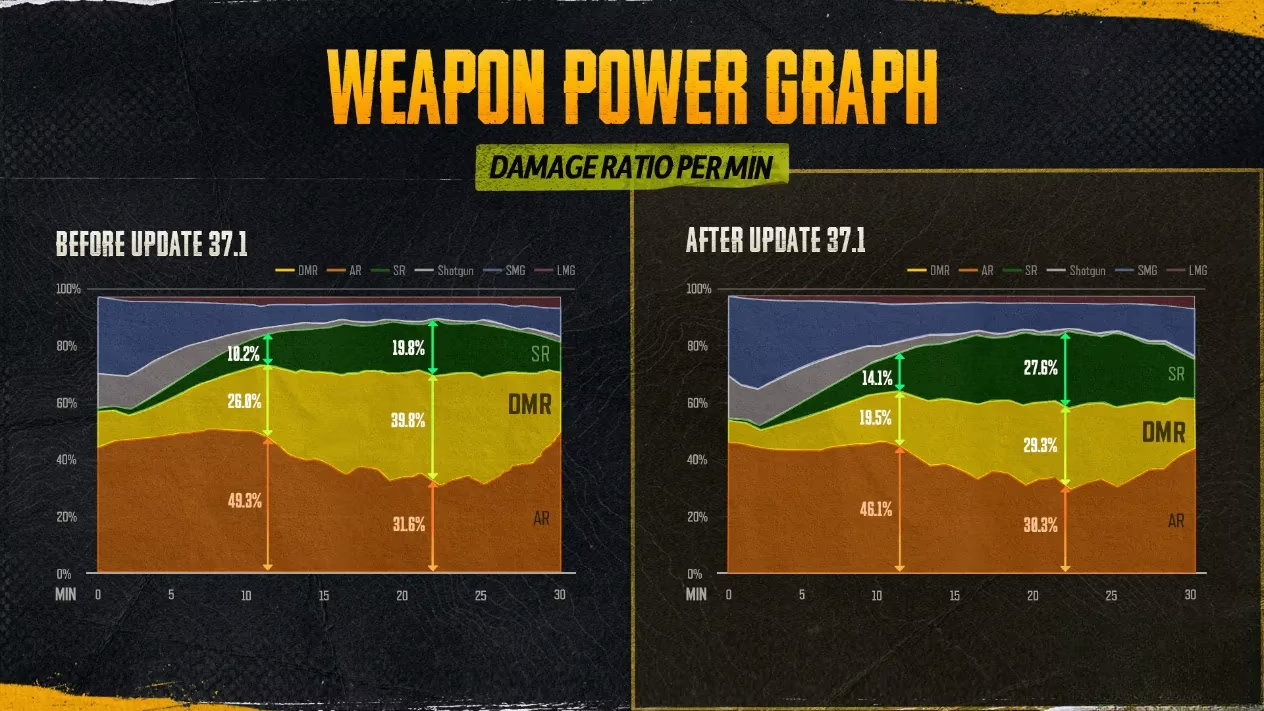
The damage ratio per minute data confirms the same trend. Before the update, mid-to-late phase damage ratios for ARs, DMRs, and SRs were 31.6%, 39.8%, and 19.8% respectively. DMRs were dealing more than twice the damage of SRs, which made them the undisputed kings of late-game rotations. After the update, those numbers became AR 30.3%, DMR 29.3%, and SR 27.6%. For me, this is one of the strongest signs that the gunplay ecosystem is moving toward equilibrium. Assault rifles remain the main workhorses, but DMRs and SRs are now close enough that your choice depends on position, playstyle, and team composition rather than raw statistical superiority.
Engagement Distance and Time to Kill
Beyond usage and damage, the rebalance also changed how players actually fight. Average engagement distance had been increasing steadily since 2023, but after the DMR Rebalance it dropped significantly from 59.4 meters to 55.7 meters. That may sound small, but in competitive play it is huge. It means the meta is shifting away from long-range standoffs and toward closer, more aggressive engagements. Players are less afraid to push because they are no longer being instantly deleted by a fast-firing DMR from 200 meters away.
Time to Kill also changed. Overall TTK had been slowly increasing until Update 37.1, but it began to decrease after the rebalance. However, DMR TTK increased sharply, which aligns perfectly with the design goal of making quick two-tap kills much less feasible. This is a natural result of reduced DMR effectiveness. As a professional player, I appreciate this because it rewards headshots and patience with SRs while keeping DMRs as a versatile but less oppressive option.
A Healthier Meta and What Comes Next
The Dev Letter summarizes the key outcomes in a way that matches my in-game experience: DMR usage has significantly decreased in both Normal Match and Ranked; DMR and SR influence has become similar in the mid-to-late stages; and average engagement distance has dropped, showing a move toward closer and more aggressive fights. The balance between 5.56mm and 7.62mm weapons is also showing signs of stability, which is important for long-term meta diversity.
That said, no major change is perfect immediately. SMGs have become even more prominent after the DMR Rebalance, and the developers are planning adjustments to their overall performance. I expect those changes to be detailed in the upcoming Patch Notes for Update 38.1. The team is also reviewing Gunplay Labs, including its operation methods and duration, based on player feedback. As someone who spends countless hours testing attachments, recoil patterns, and damage drop-off, I am excited to see how those experimental changes translate into the live game.
For now, my advice to other players is to embrace the variety. Try an SR for those mid-game power spikes, mix SMG pushes with AR support, and do not assume the old DMR meta still works. The current gunplay environment rewards adaptability, and that is a very good sign for PUBG's competitive future.
Gunplay is still the core of PUBG, and this rebalance has revitalized it in a meaningful way. I will be watching the meta as it stabilizes, and I hope the developers continue to use this kind of data-driven approach to keep the battle royale experience fresh, fair, and fun.