How I Learned to Love the Chaos: A PUBG UK Story
UK PUBG esports' chaotic early days saw underdog teams like NerdRage battle for glory in a new battleground.
It’s late summer 2017, and I’m huddled around a monitor in a sweaty flat in Birmingham, watching the ESL PUBG Invitational from Gamescom. My mates are all shouting about loot drops and circle closures, but I’m still not convinced. A hundred players dropping onto an island, scrambling for frying pans and level-three helmets? How could anyone take this seriously as an esport? Yet there I was, a year later, flying to a LAN event with my own squad and a dream that was born on those dusty Erangel hills.
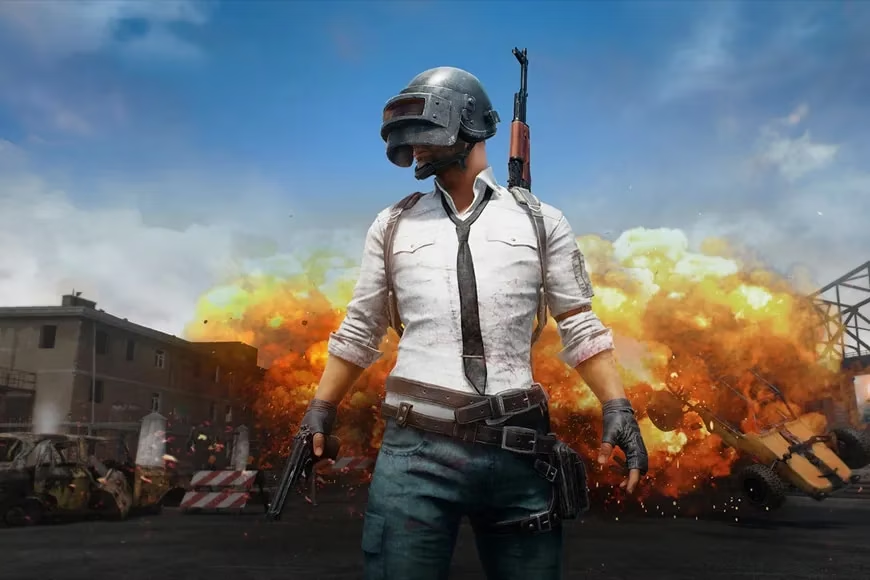
Back then, PlayerUnknown’s Battlegrounds was a phenomenon that defied all logic. It had just crossed 10 million sales and was regularly dethroning League of Legends on Twitch. The finished game was still months away, and the technical hiccups were real – desync, geometry glitches, you name it. Still, the raw tension of the last-man-standing format was intoxicating. ESL’s $350,000 Invitational in Cologne was our first taste of what could be, and I still remember the moment two UK names stood tall in the very first game: TSM’s Gary “BreaK” Marshal and Team Liquid’s Daniel “Hayz” Heaysman. I turned to my flatmate and asked, “Are we actually punching above our weight here?” The answer felt like a cautious yes.
In those early months, the UK competitive landscape was little more than a string of hopeful conversations. ESL UK, Gfinity, the UK Masters – none of them had a regular PUBG league. Multiplay dipped a toe in with a community tournament in the BYOC hall at Insomnia 61, but it lacked a proper prize pool. Online cups popped up now and then across Europe, but for a dedicated UK org to plant a flag felt like a gamble. Yet gamble they did.
Method, then the biggest UK-based organisation, announced their roster with a fanfare. Vexed Gaming fielded a team that included ex-Fnatic CoD talent radMki and Lry. Sensei fought bravely in the PUBG Online Contender Series, with player BRuZeR telling reporters, “We were ecstatic to have been invited … We managed a good showing in the first round, ending the night in sixth place overall.” And then there was NerdRage.Pro, plucking a four-man squad from the trenches and giving them the backing of DinoPC. I still recall Oliver “Tazzz” Holloway’s words as if he were speaking directly to me: “We have been everywhere in esports … but recently I have moved PUBG to the forefront. We want to see if we could make an early transition and be one of the first full UK rosters to be signed.”
At the time, many of us were asking the same question: was this a bandwagon or a genuine revolution? Rupert “Rudiak” Cary of NerdRage summed it up nicely when he said, “It’s more about teamwork and map coordination than pure skill, so any team really has a chance if they put the work in. Esports is in need of another big game … Blizzard screwed Overwatch and skin betting screwed Counter-Strike.” For someone like me, who had been floating between failed coaching gigs and second-tier MOBA teams, PUBG felt like a second chance. The game didn’t care if your reflexes had dulled slightly after five years of competing; it rewarded patience, communication, and the ability to read a shrinking circle. Could that be the great equaliser the UK scene needed?
But there was a warning echoing in the background. I remember reading Richard Lewis’ take on PUBG as an esport, and it struck a nerve. He compared the game’s last-man-standing thrill to the WWE Royal Rumble – magic that works because it’s an annual spectacle, not a weekly grind. “If you make it weekly, it loses part of its magic,” he argued. I nodded along, yet secretly I was hungry for weekly matches, group stages, any reason to boot up my PC and feel like I was building something. Were we destined to repeat the mistakes of over-saturation that had hollowed out other titles?
Fast forward to 2026, and that tension has never fully resolved. The PUBG Global Championship is a well-oiled machine now, with regional leagues across the world. The UK finally has a stable path through the PUBG EMEA circuit, and LAN events like Insomnia have evolved into serious qualifiers. Some of those 2017 pioneers are still around – a few moved into coaching, one or two became streamers with followings bigger than their old team accounts. Tazzz eventually led a team to the PGC grand finals in 2023, and Method’s investment in player infrastructure made them a European powerhouse for a time. But we also saw orgs overextend, burn out, and vanish within a year. The weekly grind Lewis cautioned against did indeed kill the magic for a while – until the community demanded fewer, more meaningful tournaments.
Looking back, what I treasure most are the grassroots moments. The in-house games started by casters like Derry and Tridd on Twitch. The late nights with Charlie Tizard throwing out a tweet: “Anyone be interested in seeing some kind of ‘UK scene’ PUBG in-house games?” The answer was always a resounding yes, and those lobbies shaped the region’s identity. Did we ever really need a franchised league? Or was the soul of UK PUBG always in those chaotic custom servers where rivals became friends and a well-placed pan could make you a legend?
If I could whisper one thing to the 2017 version of myself, it would be: “Don’t wait until it’s perfect.” The game’s rough edges were part of the charm, and the people who jumped in early – like Flow, Keys, Shy, and Tazzz under the NerdRage banner – they built the foundations we stand on today. The UK scene was never the biggest, but we learned to punch above our weight by being smarter, more cohesive, and just a little bit mad. That first ESL Invitational, flawed as it was, proved that battle royale esports could be thrilling theatre. And now, at the tail end of the PUBG era, I can say I was there, heart pounding in that sweaty flat, deciding to take the plunge. The chaos wasn’t a bug; it was the whole point.