I Survived PlayerUnknown's Insane Survival Gauntlet—And Now I'm Rebooting Reality
Prologue: Go Wayback! plunges players into a brutal survival sandbox, the first taste of Brendan Greene’s planet-scale Project Artemis.
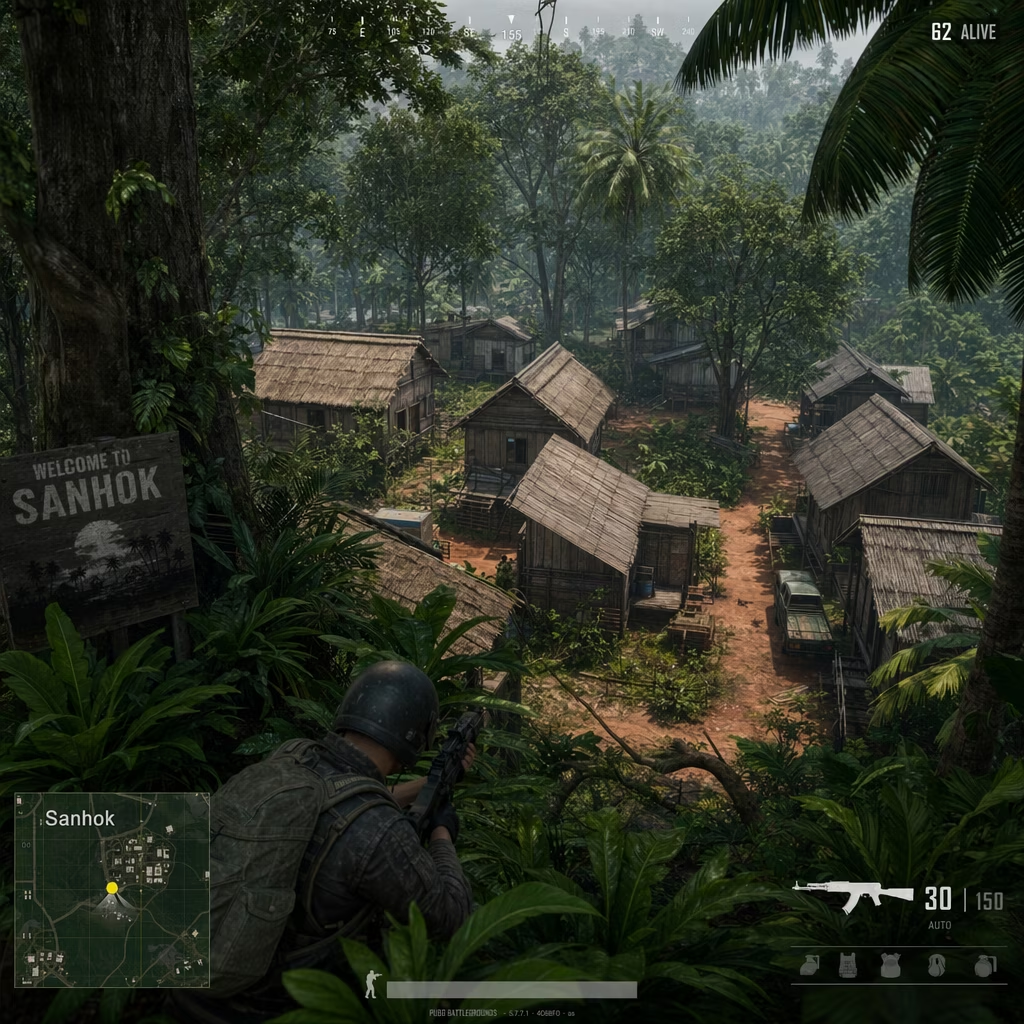
My hands are still shaking. The rain came down in sheets so thick I couldn’t see the trees two meters ahead. I slipped on a muddy slope that literally formed before my eyes, a tiny rivulet becoming a roaring stream while I desperately gnawed a raw mushroom for sustenance. This isn’t some fever dream—it’s Prologue: Go Wayback!, and I’ve been living inside its earth-shattering survival loop since it erupted into Early Access back in mid-2025. Now, in 2026, it has evolved into a feral, gorgeous nightmare that chews up casual gamers and spits out legends. But let’s rewind, because this whole saga begins with the audacious vision of one man: Brendan ‘PlayerUnknown’ Greene, who decided that an entire Earth-sized sandbox built by you was the only logical next step after conquering battle royales.
Years ago, Greene whispered of Project Artemis—a title so monstrously ambitious it would use procedural generation to craft planet-scale worlds dripping with player-created content, moddable from the mantle to the mesosphere. I remember laughing. An Earth-sized game? Sure, and I’ll ride a dragon to the moon. Yet here I am, halfway through a roadmap that’s basically an existential threat to my free time. The path to Artemis is a five-to-ten-year pilgrimage, and right now we’re in the dangerously addictive foothills. Two sacred artifacts have already landed in our laps: the free tech demo Preface: Undiscovered World, and the aforementioned Prologue, which is the first actual game in the holy trinity leading to Artemis. Buckle up, because today I’m going to drag you through my sweaty-palmed experiences with both, and then I’ll paint a picture of the promised land that’s still shimmering on the horizon.
I Dipped My Toes into a Planet—and It Screamed Back
Before I could even dream of surviving Go Wayback!, I needed to understand the engine pulsing beneath it all. Enter Preface, a free tech demo that dropped like a bombshell back in 2024 and still stands as one of the most mind-melting experiments on Steam in 2026. I downloaded it on a whim, fully expecting a glorified terrain generator. What I got was a goddamn planet-sized slap to the synapses. PlayerUnknown Productions’ in-house Melba engine doesn’t just generate landscapes; it births entire biomes with the callous indifference of a cosmic toddler. I spawned on a world that stretched beyond any loading screen—poles, deserts, jungles that looked real enough to sweat in. The tools were basic, sure: wander, observe, maybe tweak a slider or two. But the feeling? Overwhelming. I stared at a coastline that no human had ever seen before, and I could literally walk for hours and never hit an invisible wall. The studio was harvesting data from my every click, refining their beast, and I felt like an unpaid tester who’d just been handed the keys to a universe. That’s when I realized Project Artemis isn’t a pipe dream—it’s a sleeping giant.
Prologue: Go Wayback! or: How I Learned to Stop Worrying and Love the Slip-and-Slide Death March
Fast-forward to now. Prologue: Go Wayback! has been consuming my soul since its Early Access launch in Q2 2025, and let me tell you, this isn’t your cozy survival title. Every single time I press “play,” the game generates a brand-new 8×8 km map—a twisted, handcrafted-yet-procedural hellscape that demands I traverse from one edge to the other. Objective: get to the other side. Survive. That’s it. But oh, how the weather wants me dead. Dynamic systems don’t just sprinkle a bit of drizzle; they reshape the terrain with sadistic glee. Yesterday, I started a run under a crisp autumn sun. Two hours later, a downpour turned a gentle slope into a lubricated deathtrap, and I watched helplessly as a tiny creek swelled into a torrent that swept away my carefully hoarded resources. I had to scramble for a cave, shivering, while the game relentlessly modeled water physics that laughed at my flimsy shelter. And the foraging! I’ve eaten things I can’t identify—berries that made my screen go wobbly, roots that gave me back my strength, and once, a raw insect that cost me ten minutes of frantic vomiting behind a pixelated bush. The switch to Unreal Engine paid off in ways that make my GPU weep tears of joy and agony. Every leaf, every puddle, every rockfall feels like a personal vendetta.
What slays me is how Prologue embodies the grand plan. PlayerUnknown Productions has laid out a three-game gauntlet, each a stepping stone toward Artemis. Prologue is the survival crucible, testing how we interact with harsh, dynamic environments naturally generated before our eyes. It’s brutal, beautiful, and absolutely bananas. I’ve died more times than I can count—drowning in flash floods, starving because I didn’t anticipate a 20-km detour around a newly formed canyon, freezing because I gambled on a shortcut that ended in a snowstorm. And I crave every death. It’s the most masochistic, exhilarating joy I’ve felt since my first chicken dinner in PUBG. The second game in the trio is still a mystery, but rumors swirl that it’ll layer on social and construction mechanics, bringing us closer to the full modding paradise Greene envisions. The third? That’s the direct prelude to Artemis, and my brain short-circuits imagining what that might entail.
The Road to Artemis: Blockchain Dreams and Planetary Modding
Now, let’s talk about the shimmering mirage at the end of this decade-long trek. Project Artemis remains the endgame—a truly Earth-sized sandbox where every mountain, every ocean trench, every rusted nail in a shack can be player-made or player-owned. Initially, back in 2022, blockchain technology was thrown around as the secret sauce for unique ownership of procedural worlds and player-generated content. When I grilled the studio in 2026, whispers of web3 had become conspicuously quiet. No NFTs were mentioned in the latest dispatches about Preface or Prologue, and honestly? I’m relieved. The focus now seems entirely on the insane technical challenge of melding procedural generation, multiplayer persistence, and full mod support. Imagine downloading a planet that’s never existed before, then importing a friend’s custom biome sculpted with Melba tools, then hosting a civilization-building war with 10,000 other players. That’s the Artemis promise, and it’s deliciously unhinged.
The technology stack emerging from Prologue is staggering. The Melba engine isn’t just a terrain toy; it’s being honed to handle real-time erosion, fluid dynamics, and ecological simulation. In Preface, I saw the seeds. In Prologue, I felt the teeth. By the time Artemis arrives—maybe 2028, maybe 2030, definitely someday—we could be staring at worlds that evolve and degrade without any developer input. PlayerUnknown talks about a journey of five or ten years, and as I sit here in 2026, two milestones in, I finally believe him. This isn’t just another survival game. It’s a genuflection at the altar of emergent gameplay, and I’m here for the chaos. So if you haven’t yet, go download Preface on Steam—it’s still free, still baffling, and still sublime. Then pick up Prologue: Go Wayback! and join me in the mud. We’ve got a planet to build, one forehead-slapping death at a time.