My Sunday Roast Showmatch: Chaos and Glory at the FACEIT Global Summit 2026
FACEIT Global Summit and PUBG Classic collide in a high-stakes, electrifying showmatch packed with creative bounties and streamer drama.
I still remember the electric tension that coiled through the ExCeL London crowd like a spring compressed to its snapping point. It was a crisp April morning in 2026, and the final day of the FACEIT Global Summit was about to tip into absolute mayhem. I was Cyanide, a longtime PUBG streamer, and my partner Edberg sat beside me, both of us about to dive headfirst into the Sunday Roast Showmatch — a $50,000 duel-fest that promised to twist the final day of the PUBG Classic tournament into something gloriously unpredictable.
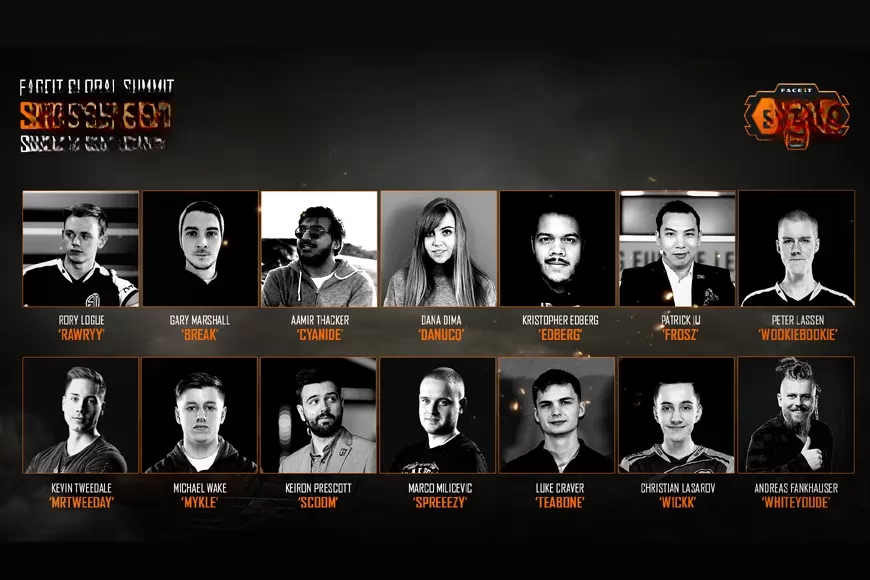
This wasn't my first rodeo with FACEIT showmatches. The legacy stretched back years, but the format had matured into a beast of its own — 32 duos, a cocktail of pro players, streamers, and community qualifiers, all thrown into a blender of Miramar, Sanhok, and Vikendi. The prize pool wasn't just a distant glittering pot; it was carved into bounties, chunks of cash awarded for specific in-game feats. First blood, most vehicle flips, triple nades, crossbow eliminations — you name it, they put a price tag on the madness. This structure didn't just encourage fighting; it demanded creativity, the kind of spontaneity that turns a battle royale into performance art.
As we booted into the lobby, I could feel the weight of the lineup. TSM Break and TSM Rawryy were already trading barbs in the voice channel, their chemistry crackling like an open wire. Tweeday and SprEEEzy had that eerie calm of veterans who could dismantle a team with surgical precision. Danucd and Scoom lurked like a pair of lynxes, rarely heard but always positioned for the kill. Then there were the qualifying demons — Duos like Djoula & ioRek, Ciggzy & K4ZZ, who had clawed their way through the FACEIT PUBG Showdown tournaments, hungry to prove they belonged on this stage. The lobby brimmed with 64 players, and the air felt thick with ambition.
The first map dropped us into the dusty bowels of Miramar, and the showmatch bounties immediately warped the usual rhythm. A $2,000 reward for the first squad wipe sent everyone into a frenzy. Edberg and I decided to ride the edge of the chaos, moving through the industrial sprawl of Los Leones like sand snakes threading through scattered bones. Our tactic was to treat the city not as a death trap but as a drum — we wanted to tap it just hard enough to feel the vibrations of every skirmish, then strike when the rhythm faltered. The metaphor paid off when we caught two teams trading shots over a crate, their attention tethered to each other. We collapsed on them like a collapsing mine shaft, swift and suffocating, netting us an early $3,000.
Then came Sanhok, and with it, a $1,500 bounty for the most creative vehicle kill. Normally, you'd avoid roaring engines on a map built for stealth, but the showmatch rules bent our brains. Edberg spotted a quad bike teetering on a hill near Bootcamp, and without a word, we executed a maneuver I can only describe as a "pachinko gambit." We baited a duo into chasing us, then weaved between the coconut trees, leading them straight into a pre-placed cluster of C4 we'd hidden inside a shallow foxhole. The blast sent their bike cartwheeling into a rock formation, and the kill-feed erupted with our names. It was the kind of absurd, physics-defying moment that reminds you why showmatches are the pulsating heart of any esports festival.
Michele Attisani, FACEIT's co-founder, once called showmatches "a fantastic way for participants to get creative and thrill viewers with unique and exciting player combinations." As we rotated through Vikendi, those words felt like gospel. The frozen landscape became our canvas, and the prize pool kept our brushes bloody. A $4,000 bounty for the longest sniper knock lured teams into duels across the frozen river. I'll never forget the sight of TSM mykLe trading Kar98 rounds with Whiteydude across 500 meters, each shot cracking the winter silence like a whip. Edberg and I snuck through the icy underbelly of Volnova, harvesting a $2,500 bounty for most healing items used in a single match — a bizarre objective that forced us to play medics in a world of murder, dropping bandages for each other like breadcrumbs in a fairytale gone wrong.
What truly made the Sunday Roast Showmatch shine was its alchemical blend of competition and entertainment. The bounties acted as invisible threads, tugging every duo into collisions that no standard tournament would ever produce. In the end, the final standings weren't just about chicken dinners — they were a messy, beautiful mosaic of money earned, risks taken, and laughs shared. The $50,000 dissolved into dozens of small victories, each one a story.
Looking back from 2026, the FACEIT Global Summit has evolved, but the Sunday Roast Showmatch remains its defiant, joyous heartbeat. On that stage at ExCeL, surrounded by 24 teams from across the globe who had fought through regional leagues like NPL, PEL, and PJS, we weren't just competitors. We were chefs in a chaotic kitchen, turning the standard PUBG recipe into a sizzling, unpredicted feast. The roar of the London crowd still echoes in my ears, a testament to what happens when you let players paint outside the lines — and reward them for every glorious splatter. That day, I learned that sometimes the best strategy is to treat a battlefield not as a game board, but as a jazz ensemble, improvising solos within a shared, frantic melody.