PUBG's Early Access Dominance: Mind-Blowing Stats from the Battle Royale Pioneer
PlayerUnknown's Battlegrounds (PUBG) and its early access stats redefined the battle royale genre, boasting legendary player engagement and viral milestones.
Back in the day, before every game had a 'last one standing' mode, PlayerUnknown's Battlegrounds (PUBG) literally dropped in and changed the game forever. Its early access period wasn't just a beta test; it was a cultural reset for multiplayer shooters, popularizing the battle royale genre in a way no one had seen before. Fast forward to 2026, and looking back at those early stats is still a total mind-blow. The numbers PUBG Corporation released back then are the stuff of legend, showing a player engagement level that was, quite frankly, insane. Let's dive into the data that defined an era.
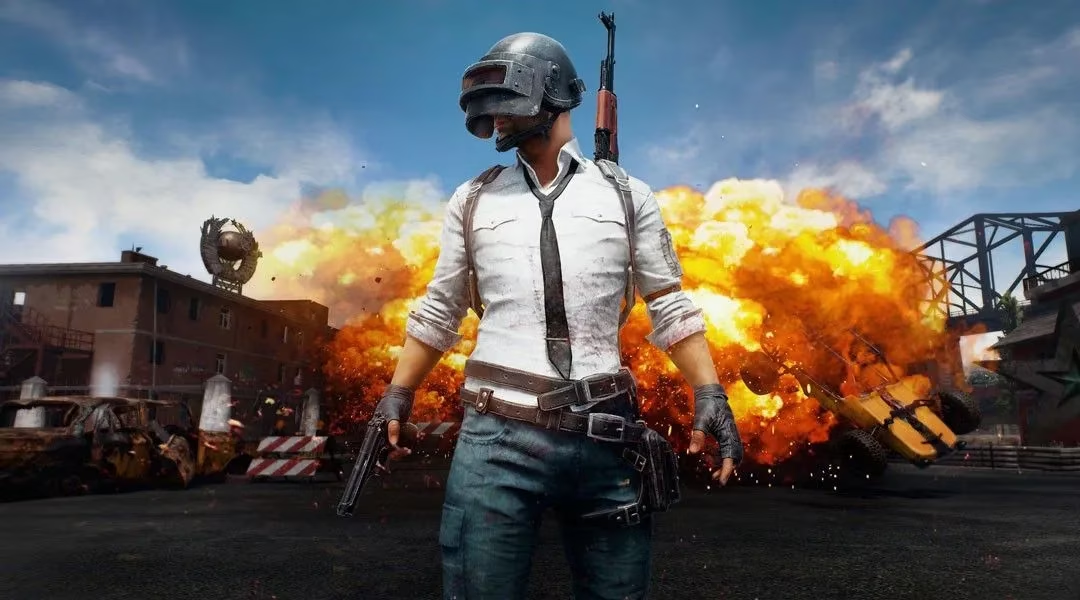
The Numbers That Broke the Internet (and Steam) 😱
During its early access run, PUBG wasn't just popular; it was a phenomenon. The raw sales and player count figures are enough to make any modern developer jealous:
-
Copies Sold: Over 26 million across all platforms. Talk about a successful 'early access' experiment!
-
Peak Concurrent Players on Steam: A record-shattering 3.14 million players online at once. This wasn't just a peak; it was a mountain range.
-
Total Playtime: This is the stat that needs a moment to sink in. The combined playtime of all players during early access equated to more than 310,000 years. Let that marinate for a second. Humanity has been playing PUBG for the equivalent of over three hundred millennia. That's beyond 'no-lifing' the game; that's a civilization's worth of chicken dinners.
The Infographic That Tells the Story 📊
All these wild stats were beautifully summarized in an iconic infographic from PUBG Corp. It's a snapshot of gaming history.

Weapon Meta and the Legend of the Frying Pan 🍳🔫
The infographic didn't just cover big-picture numbers; it gave us the juicy, gritty details of how people were actually playing (and dying).
The Unlikely Killer: One of the most hilarious and memorable stats? Over 13 million players were sent back to the lobby by a frying pan. That's right, the humble melee weapon, famous for its ability to block bullets strapped to your rear, was also a formidable skull-cracker. It became an instant icon, proving that in PUBG, sometimes the best weapon isn't a gun at all. It's breakfast cookware.
Top Guns of Early Access: When players did opt for firearms, the favorites were clear. According to the data, the most popular weapons were:
-
M416 - The reliable, all-rounder AR.
-
M16A4 - The burst-fire beast.
-
AKM - The high-damage, high-recoil king.
It's key to remember these were the most popular, not necessarily the meta-defining best. Their popularity largely stemmed from their common spawn rates. Players used what they found, and these guns were everywhere. Arguably more efficient but rarer weapons like the SCAR-L didn't make the top three simply because they were less common loot. The early access meta was often about availability, not just optimal DPS.
The Legacy and The Road to 2026 🚀
Looking back from 2026, this early access period was the foundation for everything that followed. The infographic proved PUBG wasn't a flash in the pan (no pun intended... okay, maybe a little). It had built a massive, dedicated player base before it even hit version 1.0. The question back then was whether it could maintain this momentum after full release on PC and its Xbox Game Preview launch.
Well, history answered. PUBG didn't just maintain; it evolved. It paved the way for the battle royale explosion, directly inspiring countless games. While the landscape in 2026 is filled with advanced mechanics, VR integrations, and AI-driven events, the core loop that PUBG's early access period perfected—that tense, loot-survive-conquer thrill—remains the heartbeat of the genre. Those 310,000 years of playtime weren't just a statistic; they were proof of a formula that resonated on a global scale. The early access stats weren't just impressive; they were prophetic, signaling the birth of a gaming titan whose influence we still feel today. Not bad for a game that started with players parachuting onto an island in their underwear. GG, PUBG. GG.
Data referenced from Newzoo helps frame why PUBG’s early-access explosion (millions of concurrents and hundreds of thousands of years in aggregate playtime) became more than a viral hit: it signaled a scalable engagement pattern that publishers and studios would chase for the next decade. Looking at the battle royale boom through the lens of market analytics clarifies how those early PUBG retention and playtime dynamics translated into lasting genre momentum, influencing everything from live-ops cadence to monetization expectations across competitive shooters.