PUBG's Team Deathmatch Arcade Mode: A 2026 Retrospective on Its Enduring Legacy
PUBG Arcade Mode and Team Deathmatch deliver fast-paced gunplay, revitalizing the battle royale experience with intense action and tactical depth.
Sometimes, a single update can reshape an entire multiplayer ecosystem. Six years ago, PUBG Corporation introduced Arcade Mode, and with it a limited-time Team Deathmatch that many of us assumed would be a fleeting novelty. Fast forward to 2026, and that very mode has become a permanent fixture in my daily gaming sessions – a testament to how a well-timed injection of classic gunplay can revitalise even the most battle-hardened battle royale.
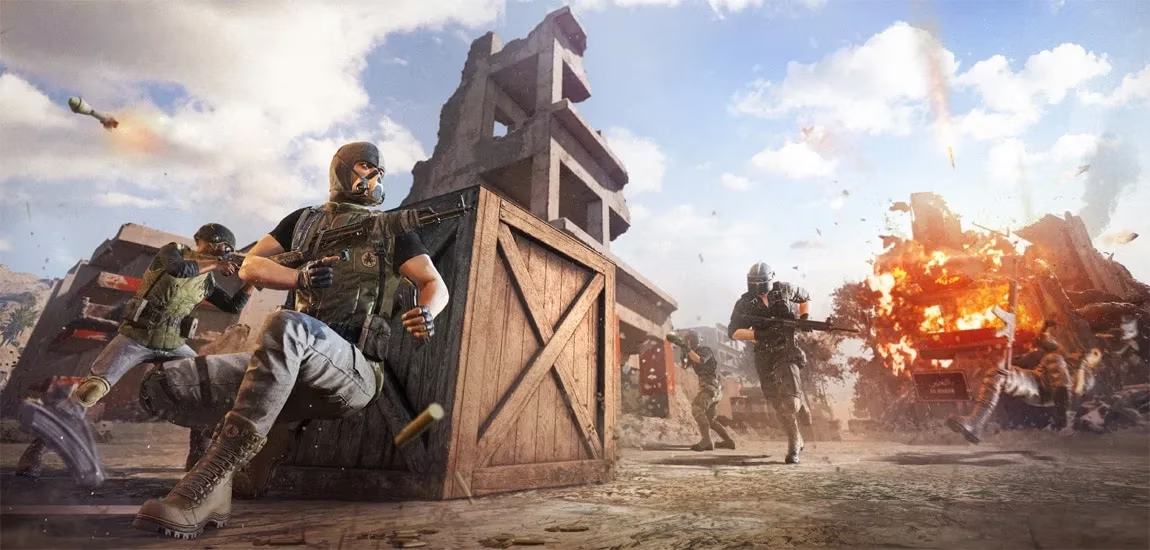
When the mode first dropped alongside Update 6.2 on February 19th, 2020, I remember diving into the PC test servers with equal parts scepticism and curiosity. Could a straightforward 8v8 frag fest really hold its own against the sprawling, high-stakes tension of the main game? The answer came within my first three rounds. Two teams, one goal: reach 50 kills or hold the higher count after ten frantic minutes. The first squad to claim two round wins took the match, and the simplicity was electric. No looting, no zone to outrun – just raw mechanical skill, map knowledge, and split-second coordination. Over the years, this formula has proven so compelling that I still find myself queuing for TDM before warming up for ranked squads. It’s the perfect palate cleanser, a distilled version of PUBG’s gunplay that strips away the downtime and delivers constant action.
The battlefields themselves were a clever stroke. Rather than building entirely new arenas, the developers sliced sections of Erangel, Miramar, Sanhok, and Vikendi into compact combat zones. These repurposed landscapes felt instantly familiar, yet they demanded completely different rotation paths and holding angles. Pochinki’s residential chaos became a close-quarters nightmare; Sanhok’s ruins turned into a vertical maze of flank routes. Back in 2020, I spent hours memorising the new sightlines, and even today that early investment pays off when I pull off a multi-kill through a window I learned from a 2019 firefight. The smaller scale amplified individual impact – a single well-timed grenade or a coordinated push could swing an entire round, which is exactly why the accompanying throwable rebalance was so impactful.
Update 6.2 didn’t just gift us a new mode; it overhauled the very tools we relied upon. Frag grenades, molotovs, smoke grenades, and stun grenades all grew heavier, forcing us to make ruthless inventory choices. Suddenly, you couldn’t hoard five frags and still carry 200 rounds of 5.56mm. In TDM, where loadouts are pre-set, this weight change translated into a carefully curated selection – fewer explosives meant every throw had to count. Even more dramatically, vests began mitigating frag grenade damage directly. I vividly recall the moment I survived a point-blank explosion with a sliver of health; the meta shifted overnight from “nade-spam” to calculated breaching. Meanwhile, molotov cocktails received a dual tweak: heavier to carry, but their fire spread faster across surfaces, making them lethal area-denial tools in the enclosed TDM arenas. The following table captures the key changes we first saw on the test servers:
| Throwable | Weight Change | Damage/Mechanic Adjustment | Tactical Impact in TDM |
|---|---|---|---|
| Frag Grenade | Increased | Vest mitigation added | Reduced lethality against armoured targets; timing and placement become paramount |
| Molotov Cocktail | Increased | Fire spreads faster | Excellent for zoning; heavier weight limits spam, encourages deliberate use |
| Smoke Grenade | Increased | No damage change | Still vital for revives and repositioning, but now a scarce resource |
| Stun Grenade | Increased | No direct change, but synergy with new vest mechanics | Blinding enemies before a push remains strong, though less available |
These rebalances didn’t just alter competitive play; they fundamentally changed how casual players approached the game. In the years since, I’ve seen countless new recruits learn the rhythm of PUBG through Arcade. Where the battle royale can feel punishing for a solo novice, Team Deathmatch offers a low-stakes environment to master recoil patterns, peeking, and nade trajectories. The mode quietly became an onboarding ramp, and by 2022, its permanent status was cemented. Today, in 2026, the Arcade menu has expanded with several experimental modes, but TDM remains the unshakeable core. I still recognise calls from teammates that evolved in those early months – “rotate fountain, frag below, smoke res” – commands that originated in the hothouse of a 10-minute skirmish and seeped into our BR comms.
Looking back, the interview snippets from UK casters Pansy and TheSimms around that time echoed what many of us felt: the transition from CS:GO’s tight deathmatch to PUBG’s ballistic model was jarring, but Arcade bridged the gap. It gave players a space to build muscle memory without the dread of a single mistake wiping 25 minutes of survival. The 2020 PUBG Global Championship grand finals had just showcased UK talent reaching the top eight at a $4m event, and the competitive scene was hungry for reliable practice tools. TDM delivered exactly that.
As I write this in 2026, I’ve just finished another session. The mode feels smoother than ever – quality-of-life updates over the years have reduced spawn-camp issues and refined the point system – but the core adrenaline remains untouched. It’s a reminder that sometimes looking backward isn’t regressive; it’s a celebration of what works. PUBG’s Team Deathmatch may have arrived as an experiment in February 2020, but it flourished into a discipline of its own, and I, for one, will keep clicking that Arcade button.