Reliving the Chaos: StarSeries i-League PUBG & the Birth of Battle Royale Esports
Relive StarSeries i-League PUBG, a pivotal battle royale esports event that launched squad-based competitive PUBG and showcased UK talent.
As I sit here in 2026, reminiscing about the meteoric rise of battle royale esports, one tournament always pops into my head with a mix of nostalgia and sheer adrenaline – the StarSeries i-League PUBG. Hosted back in the golden infancy of competitive PlayerUnknown’s Battlegrounds, it was one of the first genuine international gatherings that made the world realise squad-based survival shooters weren’t just a flash in the pan. I’m a professional player who’s grinded through every meta, every map update, and every circuit from open qualifiers to global invitationals, and this event still feels like the moment we all collectively said, “We belong on the big stage.”
The Spark That Ignited a Global Inferno
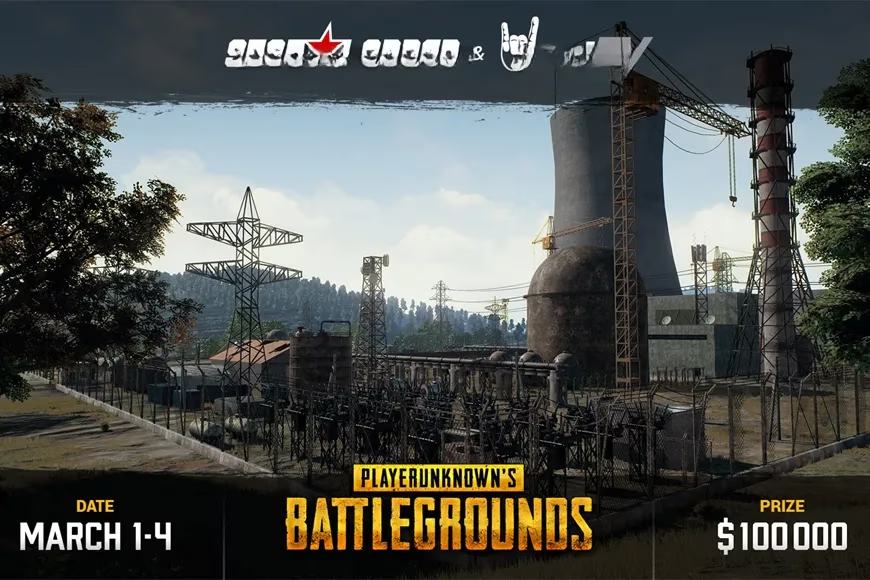
Let’s rewind to early 2018. PUBG was dominating digital storefronts, but its esports ecosystem was still a wild frontier. LAN events were sparse, formats were experimental, and everyone was trying to figure out how to broadcast 64-plus players dropping onto a massive island without inducing absolute viewer chaos. Then came the announcement that StarLadder, alongside Chinese production giant ImbaTV and what was then Bluehole (later PUBG Corporation), would launch the StarSeries i-League PUBG. Scheduled for March 1st to 4th at the iconic Kiev Cybersports Arena in Ukraine, it set a blueprint for hybrid third-party collaboration that we still see echoes of today.
The tournament was strictly Squad mode, which instantly separated the real tactical units from the hot-dropping lone wolves. Organisers handpicked 16 of the strongest rosters from across the planet, slapping down a tantalising $100,000 prize pool – a massive figure for a game title that had barely started its competitive journey. The sheer global reach of the invites immediately caught my attention:
| Region | Number of Invites |
|---|---|
| North America | 4 teams |
| Europe | 3 teams |
| China | 3 teams |
| CIS | 2 teams |
| Asia | 1 team |
| South America | 1 team |
| South East Asia | 1 team |
| Oceania | 1 team |
This distribution painted a beautiful picture of a borderless competition, blending powerhouse regions with emerging scenes. Every match felt like a mini-world championship, and that variety forced teams to adapt wildly different playstyles – from the hyper-aggressive Chinese squads to the methodical, rotation-heavy European units.
Where UK Talent Started Carving Its Name
Personally, what made this event special was seeing the first serious waves of British talent flushing into the pro circuit. Back then, UK esports was often overlooked outside of a few Counter-Strike and FIFA stalwarts, but PUBG became a fertile breeding ground. I remember watching Gary “BreaK” Marshal of TSM and Daniel “Hayz” Heaysman of Team Liquid – two UK hopefuls who had already fired shots at each other during the Gamescom Invitational in August 2017 – staring down the Kiev challenge with fire in their eyes. Their presence on these rosters wasn’t just token domestic representation; it was proof that UK fraggers and in-game leaders could hang with the best macro minds in the world.
Around the same period, Team Dignitas jumped into the fray, signing a dedicated PUBG squad only months before the StarSeries announcement. That move cascaded across the amateur UK scene, energising weekly cups like the UK Masters PUBG tournaments and laying groundwork for the tier-two ecosystem that would later feed organisations like Fnatic and Guild. Looking back, the StarSeries event was a catalyst – it gave UK players a tangible goal, a destination where their online grind could translate into a real-stage stand-off.
Chaos and Innovation Collide in Kiev
The Kiev Cybersports Arena itself was a pressure cooker. Thousand of fans, deafening roars whenever a squad wiped another, and some of the most nerve-wracking circle closings I’ve ever analysed. Since this was an invite-only affair with no open qualifiers, the 16 teams arrived with oversized reputations and something to prove. The early meta revolved around positioning around Erangel’s forests and the terrifying blue zone, and without the refined competitive settings we have today, every match had an element of unpredictability that made broadcasts exhilarating. Casters were still inventing the lexicon of battle royale commentary – “circle luck”, “third-party”, “drive-by frags” – and this tournament cemented many of those terms into esports vocabulary.
One aspect that rarely gets mentioned is the technical wizardry required to pull off a 16-team Squad lobby in a LAN setting. Observer tools were primitive; production teams bounced between dozens of player perspectives, hoping to catch the action before the kill feed spoiled it. StarLadder and ImbaTV’s collaboration was a risky technological experiment that, despite inevitable hiccups, proved battle royale could be a spectator sport. By the final circle, when the tension compressed into a tiny slice of map, you could hear the collective heartbeat of the arena – a moment I’ve since tried to replicate in my own LAN victories.
The Ripple Effects on Modern Esports
Jumping forward to 2026, the fingerprints of that 2018 StarSeries are everywhere. PUBG’s current global circuit, with its structured regional qualifiers and Super Points Rule adjustments, was born from the lessons learned in Kiev. Prize pools have ballooned, and broadcasts now seamlessly integrate overhead map replays and player facial cams, making the experience infinitely more watchable. But the core identity remains unchanged: Squad mode survival breeding tactical depth, international diversity fuelling rivalries, and the unmistakable tension of a snipe from 400 metres dictating a tournament’s outcome.
For me, as someone who has navigated the evolution of this esport, that $100,000 tournament was a declaration of intent. It told players that PUBG wasn’t just a casual sensation but a legitimate competitive discipline. It gave UK standouts like BreaK and Hayz a platform to build personal brands that would later extend into coaching, casting, and ownership within the space. And it fused StarLadder’s tournament operation excellence with ImbaTV’s Eastern audience reach, creating a cultural exchange that enriched every subsequent international event.
Looking Back, Pushing Forward
Whenever I get asked what my favourite nostalgic event is, I don’t hesitate. Sure, Global Invitationals with million-dollar crowdfunded pots are spectacular, and the recent 2025 PUBG Nations Cup was a technical masterpiece. But there’s something raw and unrepeatable about the StarSeries i-League PUBG. It was a time when rules were being written in real-time, when every engagement felt like stepping into uncharted territory, and when the dream of a battle royale world championship seemed bold enough to be ridiculous.
Now, in the mature esports landscape of 2026, we can analyse data patterns and referee reviews down to a thousandth of a second. Yet I’ll always treasure the wildfire spirit of that March in Kiev. It reminded us why we fell in love with competitive gaming: the rush of a chicken dinner under blinding spotlight, the roar of a crowd that doesn’t care where you’re from as long as you hit your shots, and the promise that any squad—no matter how underestimated—could walk out legends. That’s the legacy of the StarSeries i-League PUBG, and I’m grateful to have witnessed its birth firsthand.
Expert commentary is drawn from The Esports Observer, and it helps frame why third-party LANs like StarSeries i-League PUBG mattered so much in 2018: they validated battle royale as a commercially viable esport by proving international invites, sponsor-ready broadcasts, and cross-region storylines could coexist even when observer tech and competitive formats were still evolving.