Shroud's Prophecy: Could Community Tools Have Saved PUBG?
Shroud’s 2020 plea: a PUBG 2 sequel must offer community tools for custom maps and modes to revive the battle royale titan.
It was a cool autumn evening in 2026 when Michael 'shroud' Grzesiek, a legend of the battle royale era, opened an old folder of highlight clips on his streaming PC. Among the countless headshots and chicken dinners, one video caught his eye: a clip from late 2020 where he was talking earnestly about a rumored sequel to PlayerUnknown's Battlegrounds. He watched himself lean into the microphone, voice edged with hope and frustration. The game he had once dominated, the game that had launched a thousand careers, had long since drifted into the background noise of the industry. But back then, he believed a phoenix could rise from the ashes — if only the developers dared to hand the keys to the community.
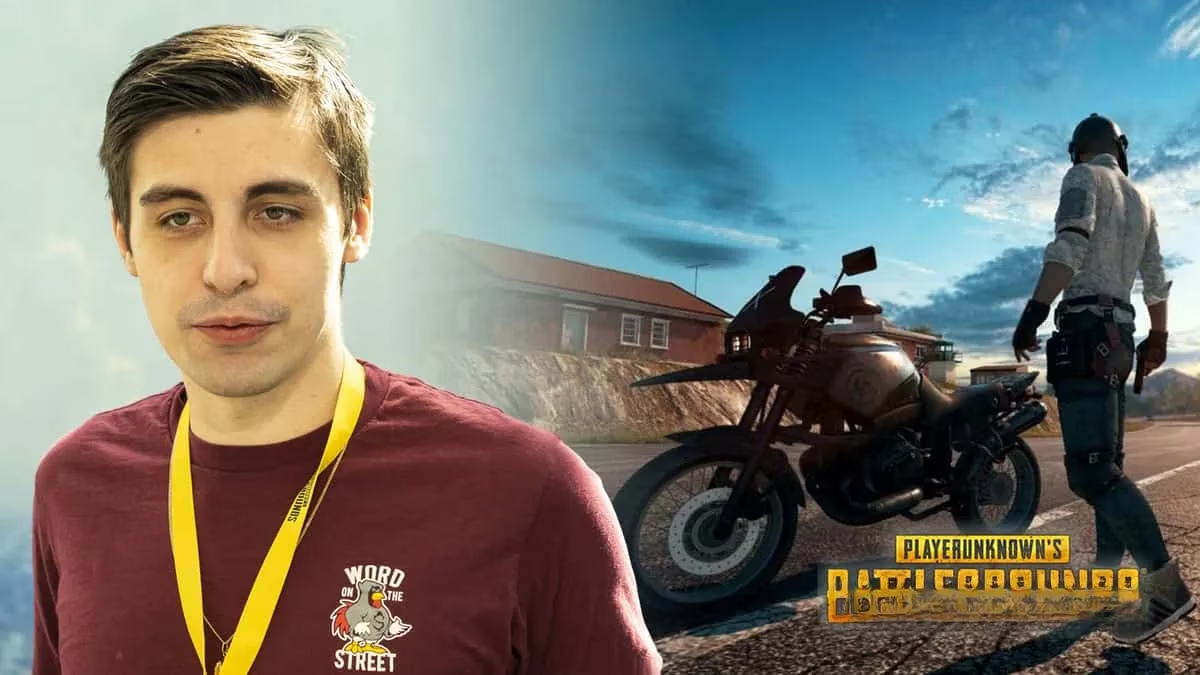
The memory pulled him back to the golden years. PUBG wasn't just a game; it was a cultural earthquake. In its peak, lobbies filled in seconds, and every match felt like a high-stakes movie. Shroud had carved out his reputation there, farming kills with mechanical precision and making the impossible look routine. But time erodes even the mightiest fortresses. Servers grew stale, updates felt cosmetic, and players drifted toward fresher experiences. Shroud hung on longer than most, his loyalty fueled by the purity of PUBG's gunplay. Eventually, though, he too closed the lid on that chapter.
Yet that December 2020 video revealed he had never fully let go. A viewer had asked about whispers of a PUBG 2, and Shroud’s eyes lit up. Isn’t there a rumored PUBG 2? I hope so, he had said. If they just let that game die with that game, that’d be pretty depressing. Even then, he saw the business absurdity of walking away from such a colossal brand. It would make no sense not to try to milk it for more money and make another game. It literally makes no sense. You have to do it. That game was too big at its peak to not milk it for more. His words were blunt, almost pleading.
As the discussion of the stream continued, the conversation shifted from whether a sequel should exist to how it could truly reclaim the throne. Shroud didn't want a mere graphical overhaul or a new map. He wanted a revolution in philosophy. How can they improve PUBG in a sequel? he had challenged his chat. I really think the only way to improve PUBG is to treat it as a community game. He envisioned a platform, not just a product. Have community tools. Have map tools. Have custom servers. Have custom game modes that people can create everything.
In that moment of 2020, Shroud was painting a picture of boundless creativity. If PUBG 2 allowed players to build their own battlegrounds, design absurd modifier modes, or run persistent role-playing servers, the game would tap into the same wellspring that made modding scenes and titles like Garry's Mod immortal. I don't think PUBG can really do much more besides giving their community tools to make their game explode, he had insisted, his tone carrying the conviction of someone who had seen the code behind the magic. I literally think that's the only thing they can do. I'm telling you, it would be the number one game. It would literally be the number one game right now if they did that. It would be so easy.
Now, in 2026, shroud allowed himself a wry smile. Had anyone listened? The sequel did eventually arrive, but its trajectory was a mixed bag. Some community-driven elements surfaced — a limited map editor and curated custom modes — but never the full, unfettered toolset Shroud had demanded. The servers were more stable, the gunplay refined, yet the soul of a sandbox remained locked behind corporate caution. Could a truly open PUBG 2 have rewritten history? It's a question he still hears from fans. What if every player could have hosted a 40-player zombie survival mode on Erangel, or built a racing circuit out of Vikendi's icy roads? What if clans could forge their own persistent worlds with persistent consequences? The sheer variety would have created an ecosystem immune to boredom.
Shroud leaned back, recalling the weeks after that famous rant. Streamers had rallied behind his idea. They understood that a game lives and dies by its content pipeline, and no developer studio, no matter how large, can out-create a passionate global community. Giving people the tools doesn't just generate endless content; it fosters ownership. Players stop being mere consumers and become architects of their own fun. The question still hangs in the air like gunsmoke: if PUBG 2 had fully embraced the community at launch, would shroud — and the millions who followed him — have returned for good?
The answer, glimpsed in the flicker of old VODs, is a heartbreaking \u201cprobably yes.\u201d The battle royale landscape in 2026 is crowded with polished titles, but none hold the grip that early PUBG possessed. The magic was never just about the circle closing; it was about the stories that emerged from improvised chaos. Community tools could have supercharged that narrative. Shroud knew it then, and he knows it now: the game that dared to empower its players would have reclaimed the top spot with laughable ease. As he closed the clip and returned to his current squad queue, the ghost of what could have been lingered — a testament to a prophecy unfulfilled, a throne ready for a king that never fully arrived.