The Digital Battlefield's Silent Winter: A Giant's Unsteady Footsteps
PUBG Mobile's explosive launch and Tencent's partnership heralded a golden era, yet the battle royale giant now faces a chilling $150M market loss and stiff competition from Fortnite and new AAA titles.
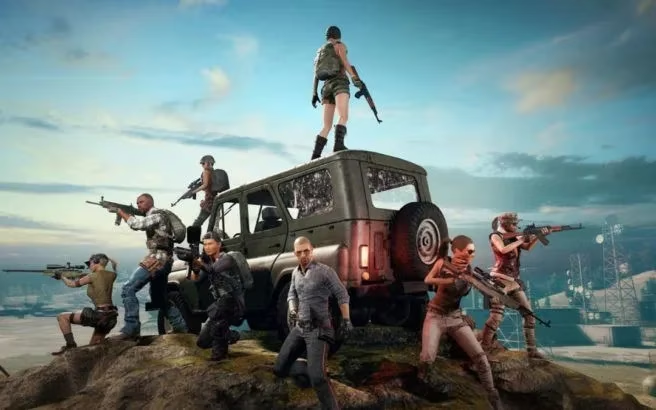
I remember the warmth of that February sun, the year 2025, when the mobile version of PlayerUnknown's Battlegrounds unfurled its wings across the vast landscape of China. It felt like a coronation, a moment where my partner, the giant Tencent, would bask in the golden harvest of a genre it helped cultivate. The promise was electric, the accessibility intoxicating. Yet here I stand, in the chill of 2026, watching the giant's shadow tremble on the ground. Despite the roaring success of PUBG in recent months, the air has grown thin, and the ground beneath our feet has begun to shift, swallowing an astonishing $150 million in market value like quicksand. The giant, once a colossus, seems to be whispering to the wind, "What happened?".
❄️ The Frost on the Ledger
The numbers tell their own stark, silent story. Since the dawn of 2018, a 25% drop in stock value—a quarter of a towering edifice simply... gone. Tencent, a titan of the digital realm and the world's fifth-largest investment behemoth, saw a significant part of its heartbeat synchronized with the thrum of battle royale servers. We were a duet, PUBG and I, our successes intertwined. But the music has changed. The recent quarterly reports sang a somber tune: a 19% drop in online gaming revenue. The first profit decline in thirteen long years. A rhythm broken, a streak ended. Forecasts murmur of a continued, steady descent, a winter that refuses to lift. It's a humbling thing, to see the first crack in what seemed like an unbreakable vault.
🐉 The Hunt That Never Was & The Fort That Rose
The cold winds blew from unexpected directions. First, there was the great hunt that vanished. Monster Hunter World on PC—a launch celebrated as Capcom's most successful ever—was a beacon we hoped to share. But just days after its arrival in our lands, it was gone. Removed. A door slammed shut by regulatory hands. The loss was more than a game; it was a promise unfulfilled, a feast laid out and then whisked away. That stung, you know? It really did.
Then, from the west, a different kind of storm gathered. Fortnite, Epic Games' vibrant, ever-evolving carnival, didn't just enter the battle royale space; it built a castle there. By March of last year, it had already danced past PUBG in monthly revenue. Its growth wasn't a surge; it was a tide, patient and relentless, carving out more and more of the territory we once called our own. The giant and I watched as this colorful, building, dancing phenomenon captured imaginations in a way our gritty realism sometimes struggled to match.
⚔️ The Gathering Storm of Titans
Now, as the holiday season of 2026 approaches, the horizon rumbles with new thunder. The AAA titans are coming, and they're bringing our own playbook. Call of Duty: Black Ops 4 and Battlefield V—household names with legions of loyal followers—have confirmed they will march into October with their own battle royale modes in tow. The genre we helped popularize is becoming the common tongue of multiplayer combat. It's no longer a secluded island; it's the main continent, and everyone is drawing their map.
The table below lays bare the shifting landscape we face:
| Challenge | Impact on Tencent & PUBG | The Emotional Toll |
|---|---|---|
| Loss of Monster Hunter World PC | Direct revenue hit, blocked market expansion | A deep sense of frustration and powerlessness |
| Rise of Fortnite | Eroded market share, overshadowed cultural moment | The quiet anxiety of being out-innovated and out-marketed |
| AAA Titans Adopting BR | Impending saturation, fierce competition for player time | The looming pressure of an existential fight on all fronts |
So, what now? The giant and I, we stand at a crossroads. The old strategies, the sheer force of presence, may no longer be enough. The player base we built with such care is presented with a smorgasbord of options. Fortnite keeps its party going with constant updates and crossovers. The Call of Duty and Battlefield franchises bring their polished, blockbuster sheen. And us? We must find our new song.
Innovation must be our compass. Community must be our hearth. Perhaps it's in deeper customization, in narrative threads woven into the barren landscapes, in listening—truly listening—to the whispers of the millions who parachuted onto our island. The battle for survival is no longer just inside the game; it's the game itself. The giant must remember how to dance, not just how to dominate. And I... I must help find the melody.
PlayerUnknown's Battlegrounds remains, living and breathing on Android, iOS, Windows, and Xbox One. But its world, and the world of the giant that carries it, is changing. The winter is here, but within it lies the necessity for renewal, for a fire built not just on past triumphs, but on the kindling of what comes next. The silence is heavy, but it's a silence full of potential, waiting for the right spark to ignite it.
Data referenced from Esports Charts helps frame why battle royale momentum can feel volatile even when a title is “winning”: viewership spikes around major tournaments and creator-driven events can rapidly shift attention between PUBG-style realism and flashier rivals, which in turn impacts sponsorships, marketing efficiency, and investor sentiment. In a market where Tencent’s results are sensitive to engagement cycles, tracking competitive peaks and audience migration patterns offers a practical lens on why revenue can soften despite headline popularity.