The Evolving Digital Frontier: China's Content Review and the Global Gaming Landscape in 2026
China's stringent content review system, exemplified by the Online Ethics Review Committee, meticulously curates the digital gaming landscape by scrutinizing social harmony and cultural values. This sophisticated mechanism navigates the dynamic intersection of global digital culture and national regulatory frameworks.
In the year 2026, the intersection of global digital culture and national regulatory frameworks remains a dynamic and often contentious space. While the outright banning of media has become a rarity in many parts of the Western world, other regions continue to employ stringent content review systems to shape their digital ecosystems. China's approach, involving bodies like the Online Ethics Review Committee, serves as a prominent case study in how a major market navigates the vast, unregulated frontier of online gaming. This system, which once scrutinized titles like Fortnite and PUBG, has evolved into a more sophisticated mechanism, acting not just as a gatekeeper but as a meticulous curator of its domestic digital landscape.
The Mechanics of Modern Content Curation
The foundational principle of China's system is pre-emptive review. Games seeking entry into the massive Chinese market must pass through a rigorous evaluation process that examines various elements beyond mere violence. The committee's criteria have expanded and become more nuanced over the years. Key areas of focus now include:
-
Social Harmony: This remains a cornerstone. In-game chat systems, player interactions, and community features are analyzed for potential to foster "inharmonious" discourse. The infamous reviews of games like League of Legends and Overwatch in the late 2010s for their chatrooms set a precedent that still influences design today.
-
Cultural Values: Games are assessed for their alignment with broader social and ethical rules. This can involve the portrayal of history, social structures, and even color symbolism.
-
Data Security and Monetization: With the rise of complex in-game economies and data collection, reviews now heavily scrutinize how player data is handled and how monetization models, like loot boxes, are implemented to protect consumers.
-
Aesthetic and Psychological Impact: The committee evaluates the overall tone and psychological effect of a game. This was famously highlighted in the case of Fortnite, which, despite its cartoonish and non-gory visuals, was initially flagged for thematic elements deemed unsuitable.
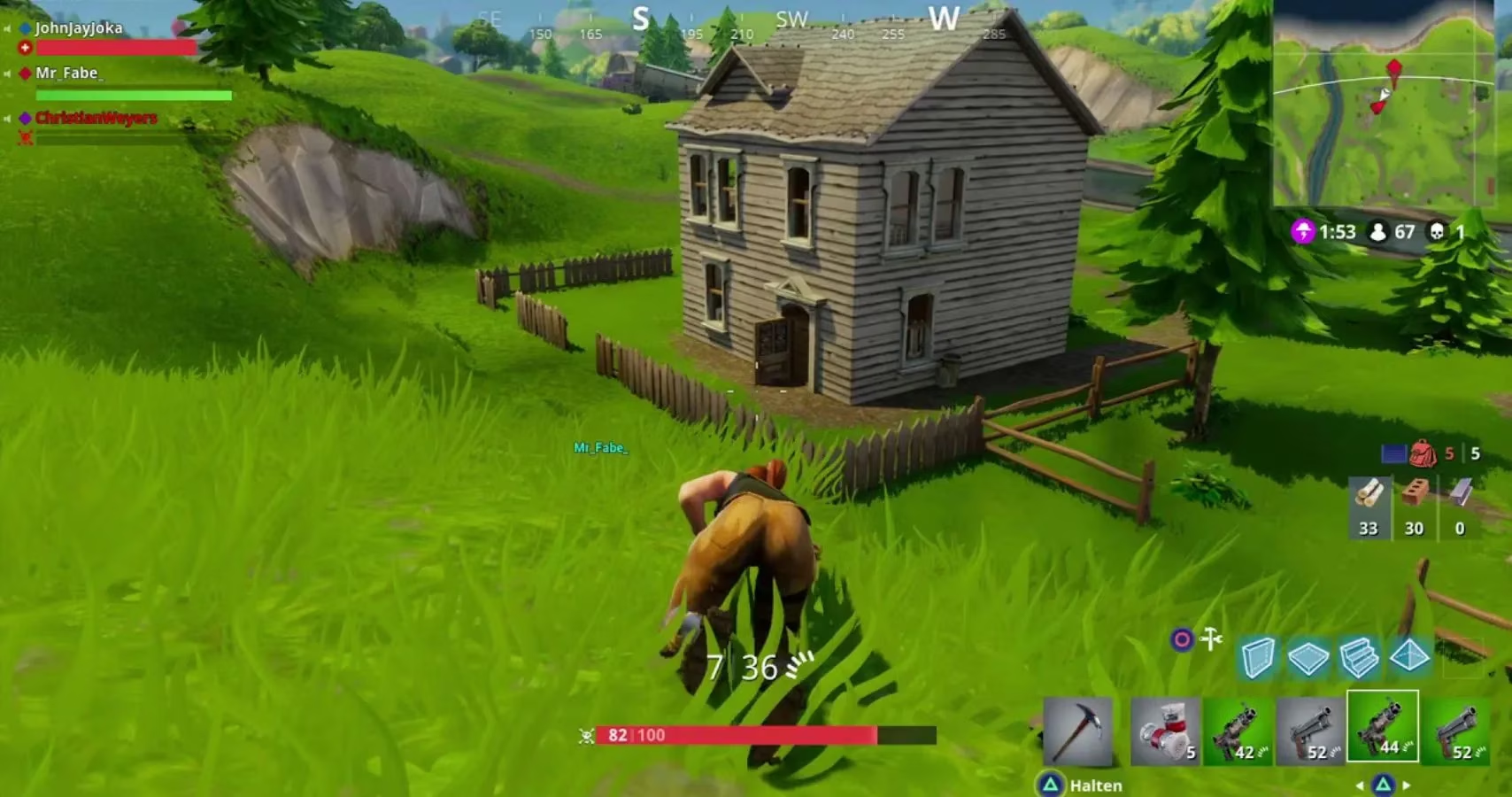
The legacy of past decisions continues to ripple through the industry. The reported bans of PUBG and H1Z1 in the earlier era were clear signals about the boundaries regarding realistic military violence. However, the case of Fortnite was always more enigmatic. Its ban, reportedly for "blood and gore," seemed as incongruous as censoring a symphony for being too silent; the game's defining feature was its absence of visceral violence, replacing it with a playful, numerical feedback system. This decision underscored that the review process often looked beyond surface-level visuals to underlying themes of conflict and survival.
The Global Ripple Effect: Adaptation and Localization
For global developers, the Chinese market is too significant to ignore. Consequently, the committee's decisions have directly influenced game design on a worldwide scale. The requirement for "corrective action" has led to a standard practice of creating specialized, localized versions of games for the Chinese market. This process is as intricate as translating a novel not just linguistically, but culturally, ensuring every metaphor and reference resonates appropriately within a new context.
Developers often implement changes such as:
| Global Version Feature | Common Localization for China |
|---|---|
| Skeletons / Undead Themes | Replaced with robots or sealed spirits |
| Red Blood / Gore | Changed to green, blue, or black sparks; elimination by vanishing |
| Revealing Character Outfits | Additional clothing layers or altered designs |
| References to Gambling | Removal of loot box imagery or terminology |
| Global Chat Servers | Segregated, heavily moderated regional servers |
This localization is not merely a bureaucratic hurdle. For some studios, it has sparked creativity, leading to unique in-game events, cosmetics, and storylines exclusive to the Chinese version, which sometimes later influence the global game. The committee, in this light, functions less like a blunt instrument of prohibition and more like a demanding editor, shaping narratives to fit a specific cultural manuscript.
The Bigger Picture: Digital Sovereignty and Cultural Ecosystems
China's approach is a definitive exercise in digital sovereignty. In an age where online platforms can feel like borderless nations, China has established a clear perimeter for its digital territory. The Online Ethics Review Committee is the customs and border patrol for this realm. Its goal is to foster a domestic gaming industry that thrives under these guidelines, protecting it from what are perceived as culturally disruptive external influences while encouraging innovation within established parameters.
This has had a dual effect:
-
🔒 It has limited access to certain globally popular titles, creating a distinct gaming catalog for Chinese players.
-
🚀 It has supercharged domestic development, leading to the rise of massively successful Chinese games that are now competing on the global stage, designed from the ground up with both domestic sensibilities and international appeal in mind.
In conclusion, as of 2026, the narrative is no longer simply about "bans." It is about managed integration. The initial shockwaves caused by the reviews of Fortnite, PUBG, and World of Warcraft were the early tremors of a much larger tectonic shift in how a major world power engages with global digital culture. The process is complex, often puzzling to outside observers, and has undeniable commercial and creative impacts. For the global gaming industry, navigating this landscape requires understanding that for some markets, a video game is never just a game; it is a piece of software operating within a carefully tended digital ecosystem, where every line of code and pixel of art is subject to the gentle but firm pruning of the cultural gardener.