The PUBG vs Fortnite Lawsuit Saga: A Look Back at the Battle Royale Legal Drama
Explore the epic PUBG vs Fortnite lawsuit, a landmark legal battle in gaming history where PUBG Corp accused Epic Games of copying its revolutionary Battle Royale mechanics. Discover the ironic twist involving Unreal Engine and the mysterious, abrupt withdrawal that left the industry stunned.
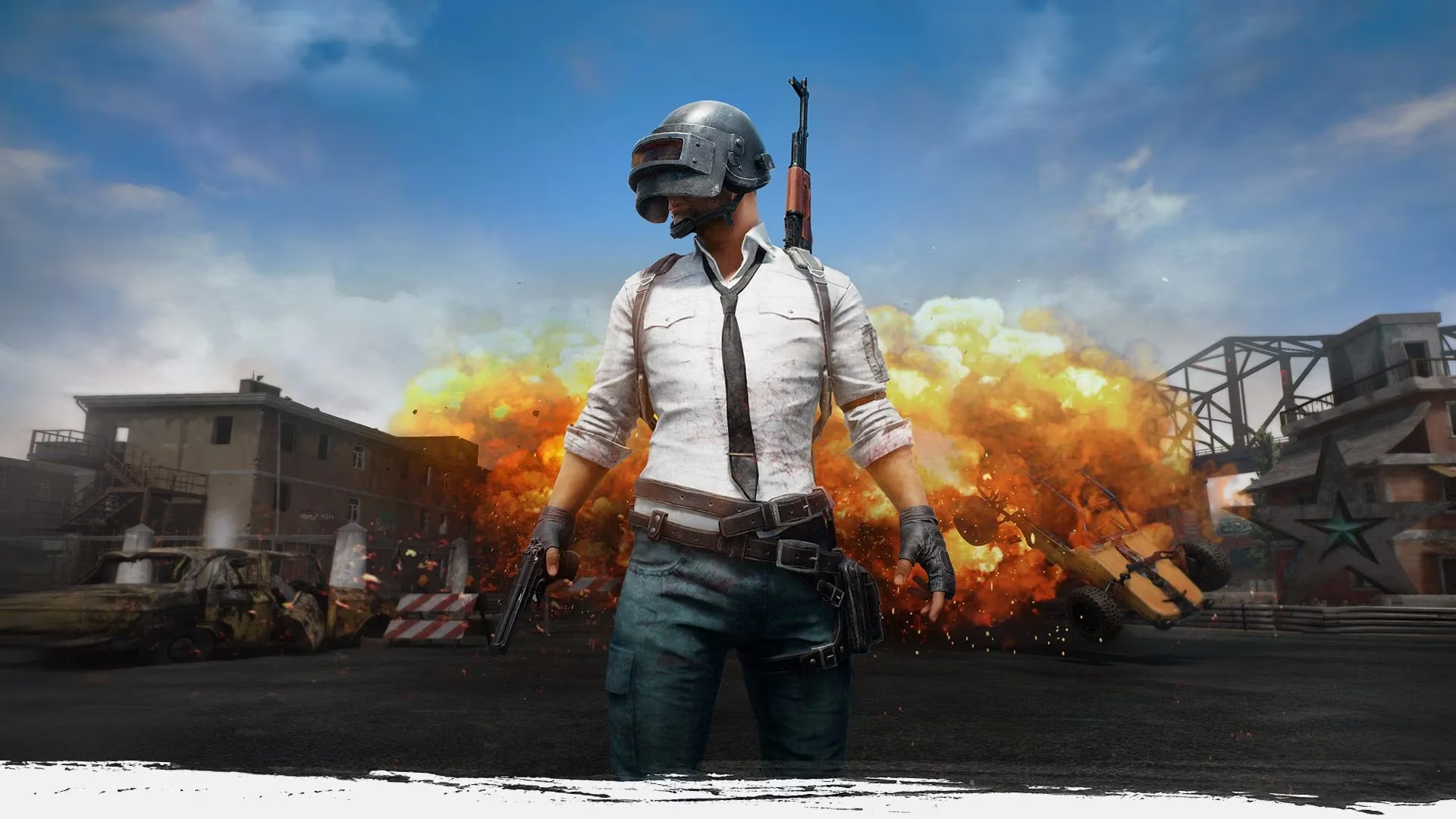
Hey everyone, it's your friendly neighborhood gaming news updater! As we look back on the gaming landscape of the late 2020s, one of the most fascinating corporate dramas was the short-lived but intense legal tussle between the titans of the Battle Royale genre. I still remember the buzz it created back then. PUBG Corps, the creators of PlayerUnknown's Battlegrounds, decided to take Epic Games, the powerhouse behind Fortnite, to court. The core of the dispute? Allegations that Fortnite's incredibly popular Battle Royale mode had a little too much in common with their own groundbreaking game. It was like watching two champions in the same weight class throw down outside the ring.
⚖️ The Lawsuit That Shook the Gaming World
Let me break down the origins of this whole situation. Back in early 2018, PUBG Corps formally initiated legal proceedings against Epic Games. From my perspective, and from what was reported at the time, their grievance was pretty straightforward. They felt that Fortnite's pivot into the Battle Royale arena wasn't just inspiration—it was infringement. The core gameplay loop, the last-player-standing premise, and various other mechanics felt, to them, directly lifted from PUBG, which had been building its community on Steam Early Access since 2017. It was a bold move, accusing one of the biggest developers in the world of copying your homework.
🔥 The Ironic Twist: Built on Unreal Engine
Here's where things got really spicy, and honestly, a bit awkward. One of the biggest complications that immediately arose—and a point everyone in the community was talking about—was the sheer irony of the situation. PlayerUnknown's Battlegrounds itself is built using Epic Games' very own Unreal Engine. Think about that for a second. You're suing the company whose tools you used to build the game you claim was copied. It created a massive conflict of interest and a tangled web of licensing and intellectual property questions. Could PUBG Corps effectively argue their game's unique identity was stolen when it relied on the competitor's foundational technology? It was a legal and philosophical headache.
📜 The Sudden and Silent Withdrawal
Now, fast forward a bit. According to a major report from Bloomberg, the whole legal battle came to a very quiet and abrupt end. PUBG Corps officially withdrew their lawsuit. Their legal team sent a letter to Epic's attorneys, and that was that. The gaming world was left scratching its head. Why? 🤔
-
No Official Reason: PUBG Corps never publicly stated why they dropped the case. No press release, no blog post, nothing.
-
No Settlement Details: There was no information on whether the two companies reached a private financial agreement or settlement behind closed doors.
-
Radio Silence from Epic: Epic Games, true to their usual form regarding legal matters, provided no comment whatsoever.
The lawsuit just... fizzled out. One day it was a major point of contention, the next it was gone from the docket. It was anti-climactic, to say the least.
💡 Why It Probably Ended: My Two Cents
While we never got official word, looking back from 2026, I think we can make some educated guesses about why PUBG Corps backed down.
-
The Unreal Engine Problem: This was likely the biggest hurdle. Pursuing a copyright case against the provider of your game's engine is a legally perilous path. It could have jeopardized their entire development pipeline and future support.
-
The Genre Defense: "Battle Royale" as a concept is based on a book and film, and the basic last-man-standing idea isn't copyrightable. Epic could have successfully argued they were iterating on a genre, not copying a specific game's expression. Games like H1Z1 and mods for ARMA existed before PUBG.
-
Market Reality: By the time the lawsuit was heating up, Fortnite had exploded into a cultural phenomenon far beyond PUBG's reach. The legal battle might have started to look like a costly distraction with a low chance of success against a now-much-larger opponent.
-
Business Pragmatism: Sometimes, it's just better to move on. Legal fights are expensive and time-consuming. They might have calculated that focusing on improving PUBG and competing in the marketplace was a better use of resources.
🎮 The Legacy of the Legal Skirmish
So, what was the outcome of this whole drama? In the immediate sense, not much changed. Both games continued to thrive and evolve in their own directions.
-
PUBG doubled down on its "realistic" tactical shooter identity.
-
Fortnite leaned even harder into its vibrant, building-centric, and constantly evolving live-service model with crossovers and events.
However, the lawsuit left a lasting mark on the industry's conversation. It sparked huge debates about:
-
Idea vs. Expression: Where is the line between innovating within a popular genre and outright copying another game's "feel" and mechanics?
-
Engine Politics: It highlighted the potential power dynamics when a developer relies on a competitor's technology stack.
-
The Speed of Trends: It showed how quickly a gaming trend can be identified, adapted, and dominated by well-resourced studios.
In the end, the PUBG vs. Fortnite lawsuit serves as a classic case study in modern gaming. It had all the elements: two juggernauts, a massively popular genre, serious legal allegations, a juicy ironic twist, and then... a mystery. It fizzled out as quietly as it began, leaving us with years of discussion and speculation. Both games have cemented their places in history, proving that in the Battle Royale arena, there can be more than one winner—even if they briefly tried to sue each other over the crown.