Thumbs of Thunder: A Six-Year Odyssey Through PUBG Mobile’s UK National Championship
PUBG Mobile National Championship UK 2021 ignited mobile esports, offering players fame and a shot at the PMPL Western Europe stage.
It’s 2026, and I can still smell the cheap energy drinks and teenage desperation that hung in the air back in 2021, when PUBG Mobile first decided to turn the UK into a tiny, battle-hardened island of mobile esports. The announcement of the inaugural PUBG Mobile National Championship (PMNC) hit my Twitter feed like a care package dropping into Pochinki—unexpected, noisy, and instantly worth fighting for. With £22,000 on the line and a direct ticket to the PUBG Mobile Pro League (PMPL) Western Europe, it was the kind of opportunity that transformed bedroom thumb-athletes into overnight regional celebrities.
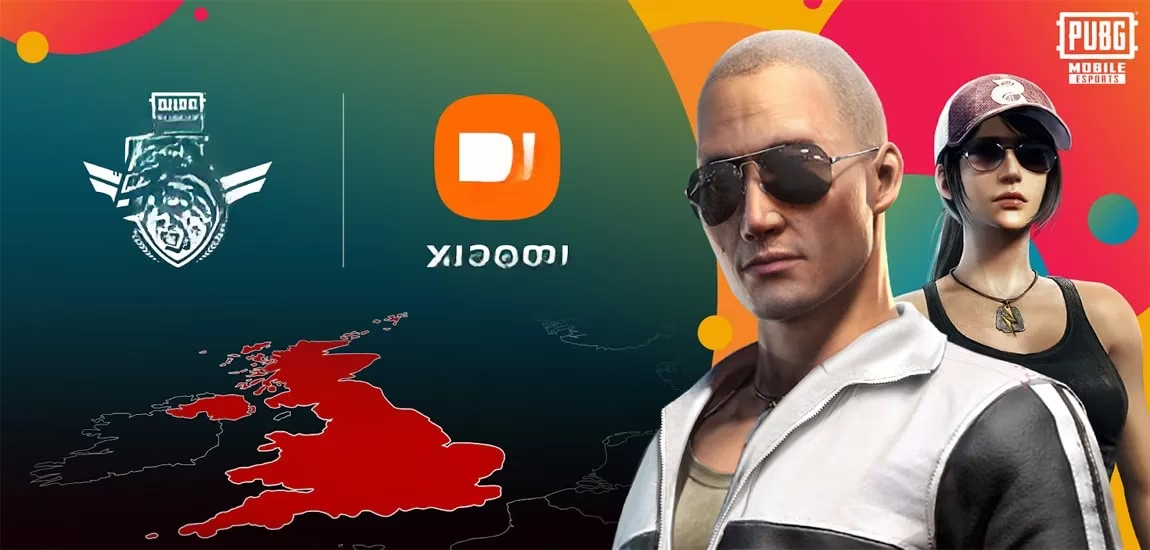
Six years later, that tournament has mushroomed into something I can only describe as a digital gladiator arena where thumbs are swords and Wi-Fi latency is the sneakiest backstabber. Back then, I was one of the thousands who scrambled to register before the May 24th deadline, meticulously assembling a roster of exactly four to six UK-based warriors, as if selecting a heist crew for the world’s least forgiving bank job. The open qualifiers stretched from June 4th to 11th, eight days of online chaos that felt like trying to defuse a bomb while riding a unicycle—one wrong move and your squad was instantly relegated to the graveyard of ‘gg go next’.
What made PMNC so intoxicating was its simplicity: no complicated regional hierarchies, no sprawling international federations, just raw, nation-versus-nation pride condensed into a mobile game. You didn’t need a high-end rig; a mid-range smartphone and a pair of thumbs blessed by the gods of gyroscope sensitivity could take you from the sofa to the finals. Watching the top 32 teams emerge from the qualifiers in 2021 was like observing a colony of ants swarming a sugar cube—frenetic, coordinated, and punctuated by the occasional spectacular explosion when someone lobbed a grenade into a three-man squad hiding in a shack.
The 2021 finals were a three-day pressure cooker simmering with teen dreams and Red Bull fumes. The best 16 teams fought for the crown, but the real prize was that golden ticket to PMPL Western Europe Season 2 in the autumn. It was the esports equivalent of finding a Narnia wardrobe in your local Tesco—suddenly, the best in the region were within reach. Our squad didn’t make it past the group stage that year, but I still remember the way my heart pounded when we wiped a semi-pro team with a perfectly synchronised flashbang push. That moment taught me that PMNC wasn’t just a tournament; it was a rite of passage for every aspiring UK PUBG Mobile player.
Roll on to 2026, and the championship has evolved into an annual festival of low-poly combat. The prize pool, once a modest £22,000, now regularly breaches six figures, thanks to a growing sponsorship family that still includes Xiaomi as a steadfast partner—their POCO phones practically the Excalibur swords of the mobile esports realm. What was once a purely online affair now culminates in a sold-out live final at an arena in Birmingham, complete with cosplayers dressed as level 3 helmets and commentators screaming themselves hoarse over boat flips and bridge campers. The format has matured too: a refined qualifier system, regional clusters feeding into a super weekend, and a grand final that borrows the tension-building point systems of its bigger sibling, the PUBG Global Championship.
Let me break down the journey for those still stuck in 2021. Here’s how the tournament structure evolved from its scrappy origins into the sleek beast it is today:
| Year | Notable Evolution | Prize Pool | Champion’s Reward |
|---|---|---|---|
| 2021 | Debut PMNC UK; online-only; 32 group-stage teams | £22,000 | PMPL Western Europe S2 spot |
| 2023 | Introduction of LAN finals; campus league merges with PMNC feeder series | £60,000 | PMPL Europe Championship slot |
| 2025 | Full regional split (North/South UK qualifiers); live broadcast on BBC iPlayer | £100,000 | Global Championship qualification points |
| 2026 | Expanded to 64 group-stage teams; dedicated female-identifying tournament track added | £130,000 | Direct invite to global league phase |
The impact rippled through the grassroots. The 2021 PUBG Mobile Campus Championship Western Europe, which ran from April 24th to May 16th, first proved that students from the UK, France, and Germany could treat mobile gaming as a legitimate competitive discipline. By 2026, that collegiate pipeline has produced several PMNC champions, and I’ve watched shy engineering undergrads transform into trash-talking, squad-wiping machines with the confidence of stockbrokers on bonus day.
For me, the most beautiful aspect of PMNC’s growth is how it fostered a genuinely inclusive community. You still need a minimum of four players from the same country, but the maximum roster size has increased to seven, allowing for substitution strategies that rival a chess grandmaster’s. The meta has shifted, vehicle physics have been tweaked, but the core remains: drop, loot, rotate, and pray your sniper has had their morning coffee. In 2026, the UK scene has its own memes, its own villains, and its own legends—players who can 360-no-scope you from a moving Dacia while you’re still trying to figure out which end of the pan to equip.
If 2021 was the ignition, 2026 is the roaring engine. The PMNC UK has become a permanent fixture in the Western European esports calendar, with a total regional prize purse now exceeding $1 million. The spring qualifiers are open again this month, and I’ll be there—not as a player, my competitive days burned out somewhere around 2024, but as a caster who describes every pineapple grenade kill as if it’s a Shakespearean death scene. Because that’s what this tournament does: it turns a mobile game into high drama, and it’s the best show on earth for anyone who’s ever yelled “Erangel, we’re dropping hot!” at a screen full of strangers.
So, charge your devices, update your sensitivity settings, and remember: the next champion could be crammed into a tiny student dorm, thumbs hovering over glass, waiting for the circle to close on their destiny. The PMNC is proof that in the UK, mobile esports isn’t just a pastime—it’s a thunderstorm of ambition, and the lightning strikes every year.