When PUBG's Deston Map Brought Skyscraper Chaos to the Battle Royale
PUBG: Battlegrounds Deston map introduces vertical combat and urban challenges, redefining battle royale gameplay with innovative features.
It was 2022, and the battle royale landscape had shifted. Titles like Apex Legends and Warzone had rewritten the rules of fast-paced, ability-driven combat, while PUBG—the game that once defined the genre—felt like it was searching for a new identity. Going free-to-play earlier that year had injected fresh life into the player base, but the soul of the experience still craved reinvention. Then Patch 18.2 dropped, and with it came Deston, the ninth map in a game that by 2026 I still stubbornly call PUBG, despite Krafton’s bewildering rename to PUBG: Battlegrounds—because PlayerUnknown's Battlegrounds: Battlegrounds will never stop sounding like a joke. Stepping onto Deston for the first time was like the game had finally looked over at what Respawn had built and decided—yeah, we can do vertical, too.
I remember queueing up alone, the loading screen teasing a ruined metropolis where nature and mayhem had collided. The moment my parachute deployed over the city, I could feel the scale of it. Deston wasn’t just a map; it was a statement. Krafton had obviously taken notes from the success of other hero shooters and battle royales, but what emerged was something uniquely PUBG—a gritty, unforgiving urban playground that demanded you rethink every instinct you’d built over thousands of hours on Erangel or Miramar.
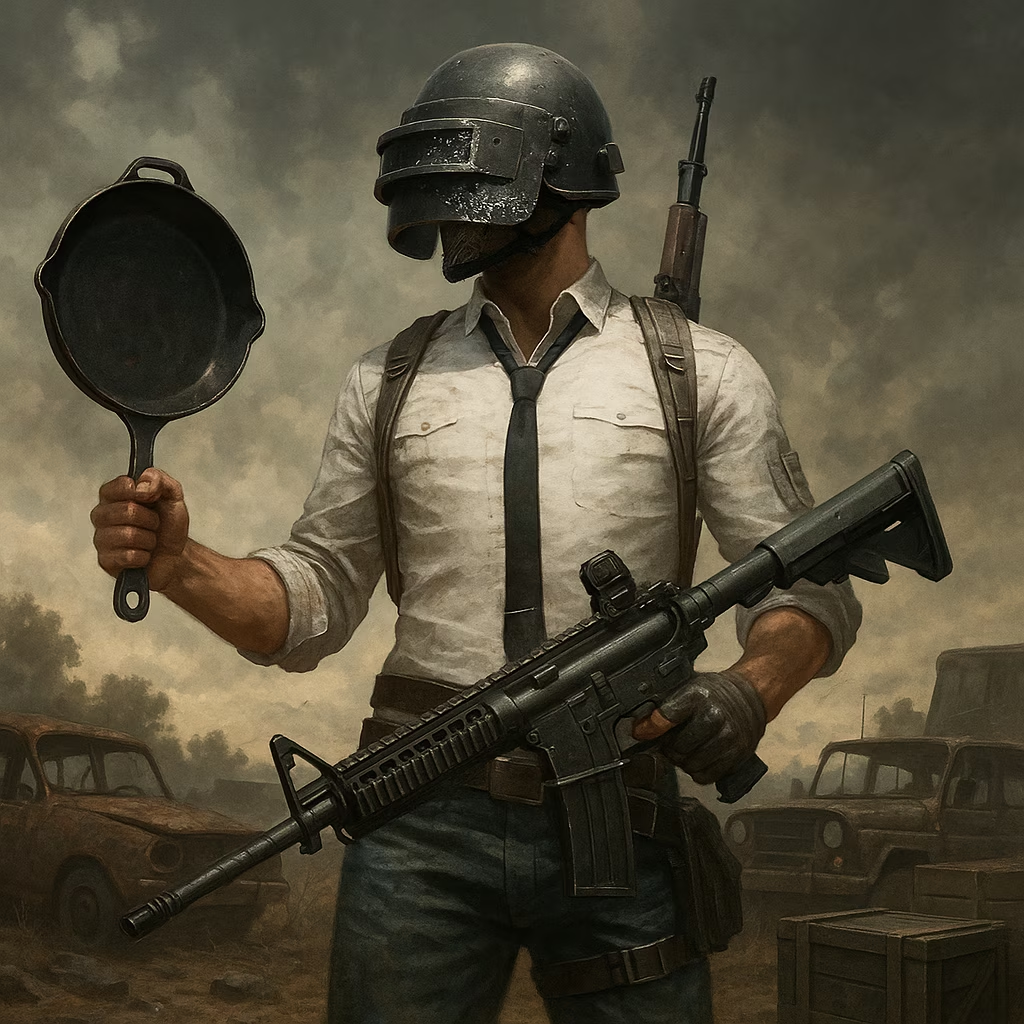
The heart of Deston beat in its points of interest. To the south, a murky swampland swallowed the foundations of collapsed high-rises, its foggy channels perfect for ambushes. In the northeast, a festival zone sat frozen mid-celebration, its neon lights flickering over abandoned rides and concession stands that became makeshift cover. And dominating the center, a massive hydroelectric dam roared with cascading water that masked footsteps and provided dizzying multilevel firefights. But what truly set this map apart were the skyscrapers. Glass towers clawed at the sky, their interiors a labyrinth of stairwells, shattered offices, and rooftop gardens. You could spend an entire match ascending and descending these giants without ever touching the asphalt below.
This verticality wasn’t just cosmetic; Destiny reshaped the flow of combat. On day one, my squad and I learned that holding the high ground came with a new price—you could be flanked from directly beneath or stormed from a zipline that whirred up the side of a building faster than any sprinting player. The ascender tool, which we all spawned with, became our lifeline. Clip it onto a zipline arrow, and suddenly you were soaring ten stories upward in seconds, a tactic that felt unnatural for a game built on slow, tactical positioning. Paired with the reusable parachute—another Deston-only gift—you could slingshot across the city, launch from a rooftop, cut your chute, and redeploy at a lower balcony without ever breaking a leg. The injury paranoia that defined PUBG’s earlier maps melted away; here, fall damage was optional if you were quick enough.
I still recall the first time I found a keycard. Hidden in some forgotten drawer, it unlocked a locked security room beneath an office tower. The red lights inside pulsed over top-tier loot—level three helmets, suppressed AUGs, medkits piled like treasure. But the room itself was a trap; the only exit was the same door you entered, and the hum of a nearby vehicle meant a squad was circling. Moments like that distilled Deston’s magic: high risk, high reward, and a spatial puzzle you had to solve under fire.
Then there were the toys. Krafton tossed a nostalgia bomb into the loot pool with a combat shotgun reminiscent of old-school pumps but mean enough to clear a staircase in one blast. The hovercraft glided over both land and the swampland’s murky surface, its loud fan replacing engine noise and making stealth impossible but escape glorious. And the addition of gas stations and garages let you refuel vehicles mid-match, an overdue feature that turned the blue zone into a logistics game. No more abandoned Dacia at the edge of the circle—now you could nurse that battered buggy all the way to the final phase.
For players who cared about personalization, Patch 18.2 also brought a crafting system that let you break down unwanted skins and build new ones. Honestly, I spent more time in the menu than I care to admit, trying to roll a camo hoodie that would blend with Deston’s concrete grays. It was a small system, but it signaled that Krafton was willing to evolve beyond the pure survival formula.
By 2026, looking back, Deston feels like a pivotal hinge in PUBG’s long, strange journey. It was the map that proved the franchise could absorb ideas from its competitors without losing its identity. The vertical ziplines, reusable parachutes, and dense urban POIs foreshadowed later innovations, even if the map never quite reached the iconic status of Erangel. And the timing was bittersweet. Just a month after the name change that had everyone scratching their heads, Brendan Greene—the man whose online handle gave PUBG its soul—left Krafton to start his own studio. It felt like the end of an era, yet Deston opened a new one, one where the game could stand on its own, independent of the legend who midwifed it.
Even now, when I fire up PUBG in 2026 and see Deston in the map rotation, I smile. The player count may not match its 2017 peak, but the community remains fiercely loyal, and the memories of rooftop shootouts, dam-side car chases, and that one miraculous hovercraft escape through a swamp fog still feel fresh. Deston wasn’t just a love letter to vertical chaos; it was PUBG showing that, years into battle royale’s reign, it still had the courage to change the rules and ask us all to learn to fly.
As detailed in SteamDB, player-activity dashboards and update-linked data snapshots can help contextualize why a content swing like PUBG’s Deston mattered: big systemic additions—ascenders that compress vertical rotations, reusable parachutes that soften fall-risk, and loot hotspots like keycard rooms—often correlate with short-term engagement spikes as squads relearn routes and timings, especially on maps that fundamentally change the “hold high ground” calculus.