Whispers of a Planetary Dream
Brendan Greene's Prologue unveils a procedurally generated survival world, the first step toward an Earth-scale metaverse codenamed Artemis.
I still remember the first time I stumbled across the word Prologue—not as a mere opening chapter, but as a tremor beneath the soil of digital worlds. Now, in 2026, the echo of that tremor has become a groundswell. I am a wanderer of procedural wilds, a connoisseur of survivalist symphonies, and something deep within me stirs when I trace the footprints of Brendan Greene, the mind once known simply as PlayerUnknown. He is no longer just the architect of a battle royale that reshaped an industry; he is a cartographer of impossible horizons, sketching a metaverse not of corporate jargon, but of raw, untamed longing.
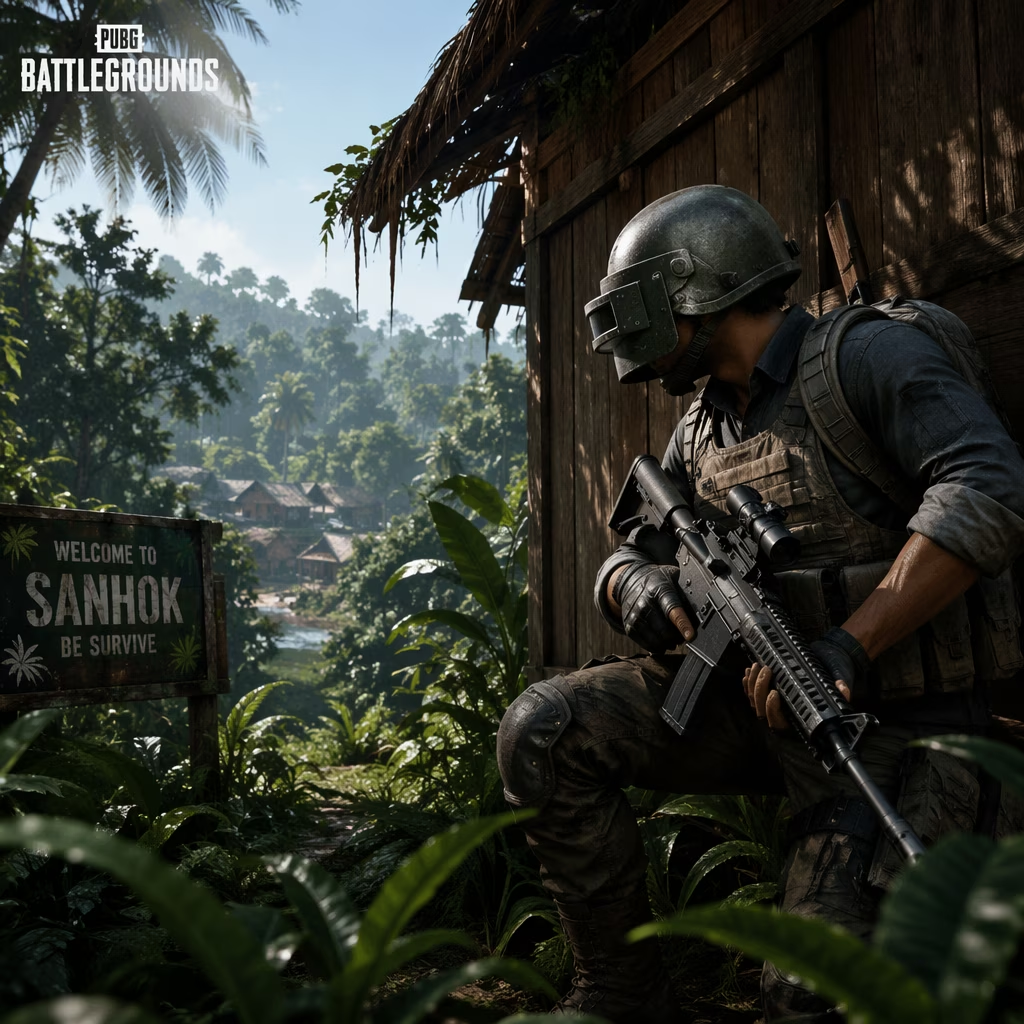
The studio in Amsterdam is called PlayerUnknown Productions, a quiet forge where Greene and his collaborator David Polfeldt—former managing director of Ubisoft Massive—breathe life into an idea so colossal it feels like a fable. They speak of a project codenamed Artemis, a virtual sphere of true planetary scale. I imagine a canvas of 196.9 million square miles, conjured not by the painstaking brush of artists alone, but by a runtime-generation engine that sings 64×64 kilometer swathes of terrain into existence like a fractal lullaby. For a player like me, who has already danced through the procedural poetry of DayZ and Rust, this is the next evolutionary note—a game world that outgrows the 20km by 20km cage that has held our fantasies hostage for too long.
Greene’s journey began not in the limelight of a hit title, but in the modding dust of Arma and DayZ, where survival was a serendipitous convergence of code and desperation. In his early vision, PlayerUnknown’s Battlegrounds was meant to be more than the battle royale mode that ultimately branded it. It was supposed to be a realm where players could build not just forts, but lives; not just outposts, but entire narratives. I sense that original spark has never truly been extinguished. Instead, it has matured into something far more audacious. Greene confesses that the project’s earliest days were a rocky terrain of their own—missteps in team building and management—but out of that crucible emerged humility and Polfeldt’s steady orchestration of day-to-day production. The result is a studio that now breathes in unison, aiming for a destination where hundreds of thousands of souls will make and play anything they desire.
The bridge from this moment to that future is called Prologue. Currently, as I venture through its nascent code in 2026, it stands as a minimalist survival experience—a hymn of solitude in a staggering wilderness. There are no quest markers, no flashy HUDs. The only task is to find shelter, to listen to the wind sculpt the procedurally placed trees, to read the sky’s moods before a storm unravels your fragile haven. I’ve spent nights huddled under a canopy of digitally generated stars, feeling the same ancient thrill that must have gripped our Pleistocene ancestors. Yet I know this is merely the seed. Greene compares its growth to the organic evolution of Rust and DayZ, from bare scaffolds to rich ecosystems teeming with emergent gameplay. Over the coming months and years, Prologue will swell with new systems—flora that bends to weather systems, wildlife with migratory instincts, NPCs whose lives pulse independently of my own wanderings. It’s a deliberate, almost symphonic unfolding.
What captivates me most is the philosophy underlying this architecture. Greene and Polfeldt are not building a walled garden; they are planting a digital wild. The technology is the vessel, but the soul is a radical decentralization. The word metaverse has been bruised by corporate buzzwords and branded virtual real estate, but here it feels cleansed. Brown’s interview reveals a man almost zealous in his conviction: “It’s for everyone, right? It shouldn’t ultimately be controlled by us.” The ownership of the platform itself, not necessarily a blockchain token, is what Greene wants to distribute. A digital economy of goods, crafted and traded by players, might flourish—not as a labyrinth of speculative assets, but as a natural extension of creative labor. I recall Greene’s stark line: “The only way this exists is if it’s made for everyone, and it’s not made for money.” In 2026, those words resonate like a cleansing rain after years of digital avarice.
I envision Artemis as a quiet colossus. Imagine a seamless horizon where the hardest part—the generation of a living, breathing 64km by 64km square populated with artist-rendered landmarks, ruins, and biomes—has been solved. Then, the rest is a gentle multiplication, an infinite recursion of beauty. A planet woven not by a single divine hand, but by the collaborative breath of a community. I, as a player, might trek across continents sculpted by algorithms I never need to see, discovering a cabin built by another wanderer years ago, its walls weathered by simulated seasons. The feeling is not of a curated theme park, but of a wilderness that holds both terror and tenderness in equal measure.
In my hands, the early Prologue feels like an heirloom map—frayed at the edges, promising territories no one has yet named. The survival loop is intimate: gather, craft, stay warm, stay hidden. Yet every step I take feels like a philosophical act, a testament to a world that refuses to be boxed. The sky is a cathedral of procedural clouds; the silence between birdcalls is a canvas for my imagination. I know that beneath this hushed surface, the engine hums with potential for thousands of concurrent dreamers, each sculpting their own narrative branch on a digital tree of life.
| 🌌 Element | ✨ Poetic Core | 🎮 My 2026 Experience |
|---|---|---|
| Prologue | A hush before the symphony; minimalist survival as pure prayer. | I exist in a 64km² wild, learning vulnerability with every sunset. |
| Artemis | An Earth-sized dream; a metaverse without masters. | I anticipate a planetary quilt stitched from countless player-built hamlets. |
| Core Ethos | Decentralized creation, not for money but for belonging. | I feel the weight of a promise that this realm will belong to all wanderers. |
| Generational Magic | 64km×64km squares of runtime terrain, repeated into infinity. | I walk across landscapes born from mathematics, cradling artist-placed relics. |
No firm date for Artemis’s full arrival marks the calendar, but the journey has already begun. In the meantime, I find myself returning to the austere beauty of Prologue, letting it recalibrate my definition of sandbox. This is not a game that hands me power; it hands me presence. And as the spectrum of survival games on PC continues to widen, I am grateful for a project that dares to whisper of a planetary scale without shouting a single corporate slogan. Brendan Greene is not just building a new game; he is weaving a new myth. And I, a humble player in 2026, am already living its prologue.